Tuesday, August 27, 2013

Part I - CT Broodstock Atlantic Salmon Fishing: Some Thoughts

It's almost that time of year again...

The autumn broodstock Atlantic salmon season Connecticut is almost upon us, possibly a little over one month away. This is the first post in a multi-part series intended to help fly anglers gear up for the 2013 season. In Part I, I will share a few thoughts on how this fishery benefits the fly angler.

Overall, this fishery is very popular with anglers, though it has its share of detractors. Some of the complaints are that the fish don't fight hard enough, it's too "artificial" of a fishery, etc. Maybe some of that is true, but it has been very enjoyable and helpful to me in some very specific ways.

Last year, I  debated the merits of this fishery with another Atlantic salmon fisherman. I am willing to bet that 100% of his salmon fishing experience has been under the watchful eye of a premier guide and probably in a canoe for a significant amount of that time. There's nothing at all wrong with that. I enjoy fishing that way. I also enjoy doing it all by myself though. There's a sense of satisfaction I get from showing up to a pool that is new to me, dissecting it, hooking a salmon on one of my flies and landing it by myself. It's a lot to get just right and it can be hard to do when one doesn't have the luxury of living near a river with a healthy and fishable run of Atlantic salmon. In many ways, the Connecticut broodstock salmon fishery has prepared me for the latter scenario.

Fall of 2011 was a cold, wet and all around strange season. As a result of a freak October snowstorm, the rivers were overflowing with frigid water. We lost power for four days and cabin fever had set in big time. With my wife home to relieve me at generator and sump pump duty, I decided to fish the Naugatuck with a buddy. The river had dropped from something like ObsceneThousand cfs to 1100cfs, which is still a very high flow. The water was bitter-cold from the snowmelt and wading was very challenging.

We were casting from the trees, so having the ability to fish a two-handed rod really came in handy that day. I used my 13' rod with a floating Compact Scandi head, an extra-fast sinking polyleader and an aluminum tube fly (a Flamethrower-type tube in L.T. Special colors, I believe). I was fishing over a reliable lie in a popular pool when a fish took my fly. The fish bolted downstream into the heavy flow. Normally I would have followed her down the pool, but that was impractical in the high water. I fought her from my furthest landing spot downstream and had to haul her, all my line and some backing against the swift current. Ultimately, I landed her and gave her a quick release.

It was a chore landing some of those fish alone that fall, but it was it was great training for my trip to the Kola Peninsula the following spring. Low water in the Kola and Kitza Rivers was an even more challenging wade than high water in the Naugatuck. Safely landing sea-liced Kola springers alone was not easy in some of those pools, but I had practiced for it, so I could take certain tough scenarios in stride.

The example above is how the broodstock fishery helped improve one or two specific skills. There were plenty of other skills I have honed along the way, such as two-handed casting, presenting wet flies and dry flies properly, waiting on the hook set (a critical skill), hooking salmon who rise but don't take, unorthodox techniques, etc...the list goes on and on. Without a salmon fishery close to home, it probably would have taken me a lot longer to figure some of this stuff out, especially when I've found myself on a wild salmon river, unguided and left to figure it out largely on my own.

Atlantic salmon fishing trips can be expensive. Before you go, it pays to be as comfortable as possible with as many scenarios as possible. Obviously, you're not going to see many of the scenarios you'd find on a wild salmon river, but there is more overlap than most anglers think. It only costs as much as a resident or non-resident Connecticut fishing license, so you might as well practice here instead of practicing wherever "there" might be (i.e. Canada, the UK, Iceland, Scandinavia, Russia, etc.). This fishery can be a great introduction to the often bizarre nature of Atlantic salmon fishing. It's a good way to learn how to shut off your "trout brain," an essential skill for anglers without a salmon fishery near home.

...and, along the way, a few of those broodstock salmon have fought pretty damn hard. Hook into enough of the early fish and you'll see what I mean. Though most are lethargic, mixed in are some barren, chrome fish which never spawned and will definitely get your attention when they go berserk, cartwheeling through the pool. I landed one last year that I swore was the hardest fight I've gotten from one of these fish until I hooked (and lost) another demon later that week. It was only in the 8-10 lb. range, which was about average size last year, but I never would have known I was on the Naugy by the way it fought (except for that special Naugatuck "ambience").  That fish fought harder than my first Russian salmon and a few of my Canadian salmon, believe it or not! Water temperature probably has something to do with this, as my most memorable broodstock salmon fights have come in early-to-mid October.

The next installment will be about tackle and gear. There are some changes this year and my tackle choices will reflect those changes. Stay tuned...

Wednesday, August 21, 2013

Gray Ghost Variant Tube Fly

A pair ready for alewife-rich waters

Until this season, I had only fished very small Gray Ghosts and not too frequently at that. I don't think I ever hooked a fish with one. While fishing Connecticut's Farmington River this past spring, I tried a larger (sz. 4) Gray Ghost and did quite well, landing several respectably sized holdover brown trout. It was in between a Hendrickson hatch and spinner fall, and it seemed like many of the larger trout preferred the larger meal.

I have a few friends who swear by this fly, so I figured I should give it a go. I wanted to tie some even larger than what I had, but was not crazy about fishing a 10x long streamer hook. I decided to convert it to a tube fly and substitute some more "modern" (read: flashy!) materials.

I have plans for these tubes...Primarily, I want to use them to target landlocked salmon this fall. Also, there are a couple of lakes nearby (one really close to home) with large seeforellen brown trout coupled with a population of landlocked alewives. I've done well fishing one lake's spawning run, but have yet to take a trophy seeforellen brown. Time to get cracking on that...

A classic Maine streamer, converted 

Gray Ghost Variant Tube Fly

Tube: 1.5" aluminum 
Tag: Flat silver diamond braid
Rib: Oval silver tinsel
Body: Flat orange Diamond Braid
Underwing: Yellow bucktail
Wing: 1. Silver fox tail w/polar ice Angel Hair
             2. Silver fox tail w/pearl Krinkle Flash
             3. Black temple dog or arctic fox, topped with four strands of 
                  peacock herl
Throat: White bucktail topped with yellow Fluoro Fiber 
Cheeks: Silver pheasant and jungle cock
Head: Black w/red thread band

Friday, August 2, 2013

Step-by-Step: How to Fold a Hackle With Your Scissors

Flamethrower tubes - Folding stiff hackles is easy with this technique

I was first made aware of the scissor folding technique by my favorite Miramichi River guide, Darryl Tucker. It took Darryl but a few seconds to fold a hackle with his scissors, while it took me much longer to fold one by hand.  Darryl pre-folds his hackles by placing the tip of the feather in the jaw of his Regal vise. I have seen tyers fold hackles with scissors while the hackle is tied into the fly, but I liked Darryl's method more. The only thing I disliked was using the vise jaws to hold the hackle. The easy solution to the problem was to use a variation of the "third hand." I dangle hackle pliers from the rotary end (cam end on an HMH) of my Renzetti Traveller vise, which frees up both of my hands (see below).

I rarely remove this helpful tool

I have a set of these brass Dr. Slick hackle pliers on both my HMH Standard and my Renzetti Traveller. I just purchased a Renzetti Master vise and, unfortunately, the vise shaft is too thick to accommodate this style of hackle pliers. Luckily, I stumbled across a tool called "Swiss pliers w/spring ring." I placed the Renzetti Master's stem through the ring end of the tool. It works great and stays out of my way (see below).

Renzetti Master Vise with Swiss Pliers

Anyhow, let's get to the step-by-step instructions on how to fold a hackle with your scissors...


Step 1: Select a hackle. This orange hackle comes from a Chinese rooster cape


Step 2: Pull downward on the barbs so they are more or less perpendicular to the stem


Step 3: Place the tip of the hackle in the dangling hackle pliers


Step 5: Use another set of hackle pliers to hold the feather steady.You can use your fingers, but I find the feather rolls less when using pliers. 


Step 6: Place the tip of your scissors against the hackle stem, just below the upper set of pliers. The tips of the scissors should be at a right angle to the barbs. 


Step 7: Drag the tips of your scissors downwards along the stem. You should feel the barbs "clicking" as the scissors fold them inwards.


Step 8: When you finish one side, repeat Step 7 on the other


Step 9: Determine if the fold will suit your needs


Step 10: If you desire, the hackle can be folded over even more with moistened fingers


The folded hackle, ready for tying in only seconds after being plucked from the neck (below)


I usually fold with the scissors then, if necessary, make manual adjustments while wrapping the hackle. I tend to stroke the fibers into place as I wrap the hackle. This is a fast and effective way to fold both body and collar hackles. If the hackle is for a fishing fly, I can fold it well enough to use in about 10-20 seconds, plucked off the neck or saddle. If it's for a show fly, I usually am a bit more careful when I fold. This technique even works with very stiff dry fly hackles, which might be otherwise difficult to fold using only your hands. 

Give it a try sometime. Make sure you feel the feather "click." You'll know what I mean when you feel it happening. If it's clicking, you're doing something right!


Sunday, July 14, 2013

New Pics From a New Camera


Chopham-tied on a 3/0 Alec Jackson (gold)

I recently invested in a Panasonic Lumix DMC-FZ200. It's a bridge camera. I didn't feel like I was ready to take the DSLR plunge quite yet, but I think this will either do the trick or, eventually, become a "gateway drug" into the world of DSLRs. I also bought some cheap, clip-on LED lamps. I'm really going to try to up my game photo-wise, so bear with me while I work out the kinks. I'm already impressed with what this camera can do despite only using 10% of what it's capable of.

Once I get my act together, look for more step-by-step posts and possibly some instructional tying videos in the future. Stay tuned...

Here are some miscellaneous shots from the first day...


The Pearl - #4 (Mustad 3371)

Jock Scott - #2 Double

Willie Gunn Dee - 3/0 Alec Jackson

Dirty Bird - #4
(more details on this one soon...a very effective fly!)


Thursday, July 11, 2013

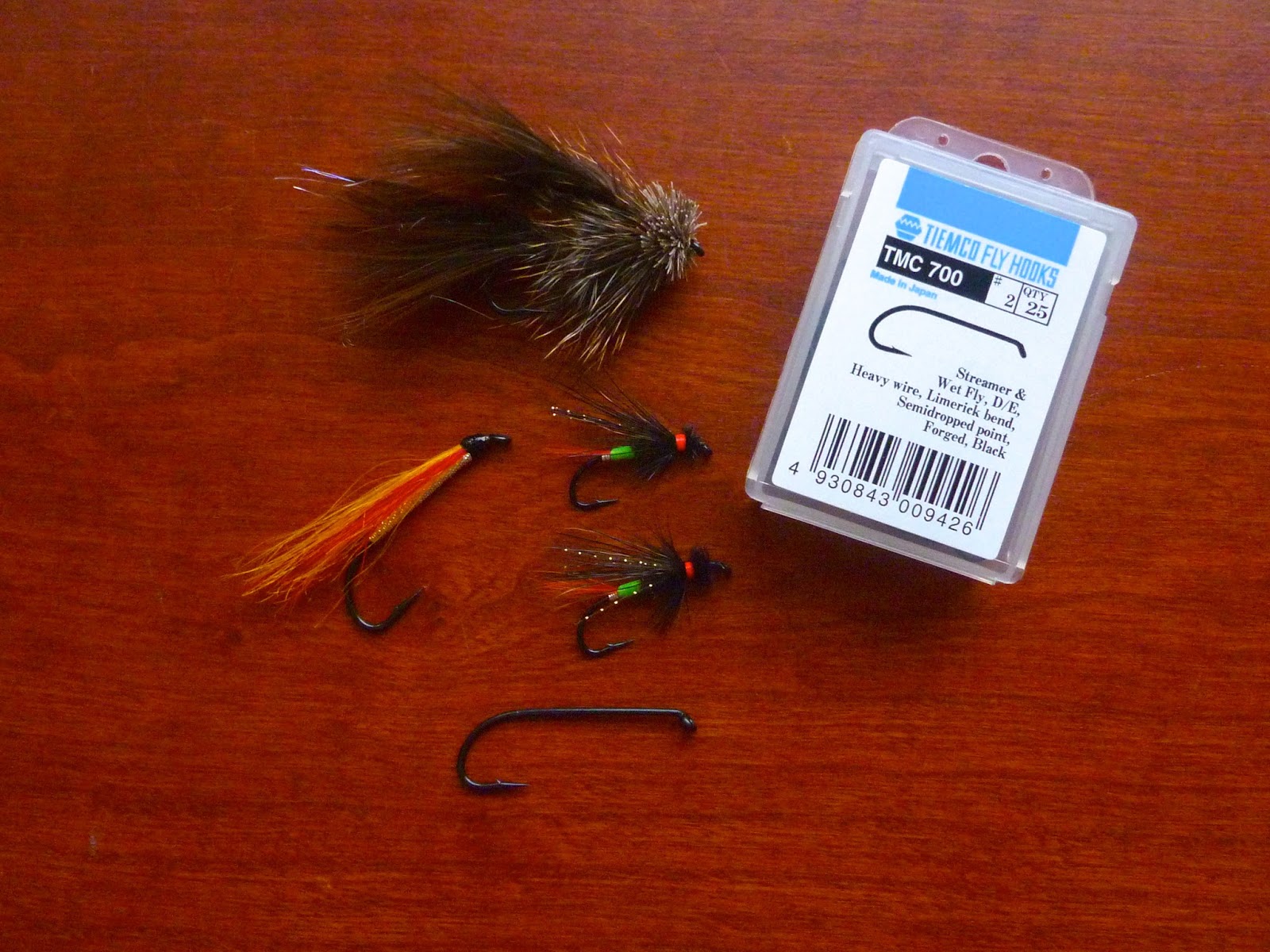
Tiemco TMC 700 - Lament for a Hook

Some of my favorite TMC 700 treatments

About a month ago, I thought I'd stock up on one of my favorite "specialty" hooks, Tiemco's TMC 700. I figured I'd need some for future orders of Connecticut Broodstock salmon flies, as I tie two of my three favorite patterns for CT salmon on these hooks (Mickey Finn and the Same Thing Murray). Little did I know that Tiemco had discontinued this model of hook not too long ago. I was shocked! I was dismayed! How dare they?!?

When I regained my composure, I hunted for sources of remaining stocks of TMC 700s. I started with the elusive size 10s and ordered the other sizes from that particular source to save on shipping. Two sizes were absent, however. TMC 700s in size 1/0 seem to be relatively abundant compared to the other sizes, ironic given that my source carried almost all the other sizes, but not 1/0. Also missing were size 4s. These proved to be the phantom of the group. They're really hard to find for some reason. I put out feelers all over the internet and was contacted by a kind gentleman in Germany who had a bulk bag of 600 for sale. I snatched them up. I didn't really need that many but I had no idea where else to find them. 

Moderation

Trying not to succumb to the serial material/hook hoarding instinct which comes naturally to fly tyers, I figured 50 of each size is enough to get me through most of the rest of my life. I just have to stop tying commercially on them, which is fine with me and I doubt my customers will mind too much. I only really use them for three patterns; Mickey Finns (for salmon), the Same Thing Murray and various Muddler variations. The thing is I really like them for Muddlers and Mickey Finns. I could live with another hook for Murrays, but I've had so much success with that fly on this hook that I'm too superstitious to change now* (which is ridiculous). 

The difference is in the wire (and the eye)

As you can see in the Tanner Chart above**, they're pretty much the same length as the heavy wire, up eye offerings from both Tiemco and Daiichi. Other than the eye and the limerick bend, the main difference is the weight of the wire. The TMC 700 is a heavy hook. The wire is substantially thicker than the Daiichi 2441 which, due to those $25 off Orvis coupons, has become my mainstay for salmon wet flies***. It appears that the wire on the 700 is marginally thicker than it's cousin, the TMC 7999. I don't really use 7999s though, at least not when I can get $50 worth of Daiichis for $25 two or three times a year. So the TMC 700 is roughly the same size as my normal hook, but weighs more. I've heard it said that down eye hooks fish slightly deeper than up eye hooks, so I like having a few flies tied on 700s to get down a tiny bit more. They really are a terrific Muddler hook if you're not trying to skate it or fish it dry. The TMC 700 is a tough hook for nasty fish. It's sharp, seems to hold well and I doubt many fish are capable of bending it.

So what I already had and what I just bought is going to have to last. At the rate I'm fishing these days, I probably bought 47 too many of each size. I plan to rectify that come autumn, however. What a drag though...I've spoken to several fellow tyers who feel similarly. Tiemco-san, if you're reading this, please let the TMC 700 live again! 


* The same goes for tying it with a moose hair wing. Just about everyone ties it with bear hair, but my first had moose, and they worked, so moose it is forever...(probably equally as ridiculous and superstitious) 

** Gary, if you're reading this, I love your hook comparison charts. Thank you!!

*** The Orvis Salmon Wet-Fly Hook is a rebranded Daiichi 2441. I wish they made a size 10 in this hook. You hear that, Daiichi-san??


Thursday, July 4, 2013

Chopham & The Outlaw

The Outlaw (above) & Chopham (below)

It's has been a while since I last posted anything here. Mid-May through the end of June was a very busy period of work for me (a good thing). I played a bunch of fun gigs and was in the studio, recording several ballads for an upcoming Chet Baker tribute album. When I wasn't working, I was at home with the little guy. It left very little time for fishing and even less time for tying. Sadly, my spring fishing season can summed up in two words...bad timing. I just couldn't seem to time anything right. First the water was way too low for my quarry, then it was way too high. Finally, I couldn't take it any longer and fished right through a tropical storm. This summer, my goal is to find a good babysitter so I can time things a little better come autumn!

I did find the time to tie up a couple of freestyle display flies this week, however. It felt good to tie this style of fly again. I think the last freestyle fly I tied was almost a year ago. I have some more ideas I'm going to try to work out while we're in the summer doldrums.

Chopham-tied on a 3/0 Alec Jackson (gold)

The "Chopham" is based on the Popham, one of the most iconic flies of the Victorian era. The indian crow subs in this fly were made by Bryant Freeman of Eskape Anglers. Because of the lack of a formal body, I aimed for an airy look overall. 


The Outlaw-tied on a 3/0 Alec Jackson (silver)

"The Outlaw" uses a color scheme that I am very fond of...black, white, red and peacock green. I can't get enough of white feathers with a black/dark accent. Amherst and silver pheasants, silver badger rooster and, in the case of this fly, speckled bustard neck hackle (throat). I'm also a sucker for embossed tinsels. Along with "The "Moon Maiden,"  and "The Bandit" (one of my first freestyle flies), this fly is the third in a series of flies in this color scheme.

Stay tuned for more in the near future...

Friday, May 17, 2013

Hammonasset Trout 1 - Little Guy 0

My future netsman

This little fella has been going more and more places lately, so I figured why not fishing? I thought I had this all figured out. We'd go to the Hammonasset River, a mere 20 minutes from home. Worst case scenario, his great aunt is only a mile away, tops. I put on my hippers before leaving home. My rod was already rigged up with a Golden Olive Dabbler and a small Silver Invicta. I figured today was the day to introduce the little guy to his first trout and I figured I had about ninety minutes of fishing time to get the job done. 

I should have taken the dirty diaper upon arrival as a sort of foreshadowing. Fortunately, the back of my Mazda Tribute is the perfect baby changing station. We took care of the stinky mess and were on our way. It was a short walk downhill to a pool where, according to my friend Pete, the trout "rise with blatant impunity."

We made it to the pool and found some small risers. Unfortunately, they were chubs. After bringing two to hand, I spotted a decent sized trout rising in the tail of the pool. Because of the nature of the pool, I had to work downstream to cover the bulk of the deeper water. I hadn't thrown close to enough line to cover that far down the pool before an unexpected thirty minute meltdown began. 

I knew we were done for the day. He wanted out of the car seat and wanted to be held. I tried to calm him down so I could get that one elusive trout and we could be on our way, but it wasn't meant to be. It was time to head home. 

I wish I could give some kind of helpful fishing report to the locals, but we weren't there long enough to see much happen. Plus, my attention was mainly focused on the bank, not the water. On the drive home, I told his mom about my shortest fishing trip ever. She replied, "30 minutes? That's a pretty good amount of time outdoors for him!" Was our trip a success? I didn't think so, but maybe I was wrong. 

I'll give him another month or two before we attempt this again. I know of a stream filled with wild trout and decent enough stroller access. In the meantime, I'll have to phone the Duke of Roxburghe and tell him to postpone our trip to the Alta River until further notice...