Monday, August 11, 2014

Almost

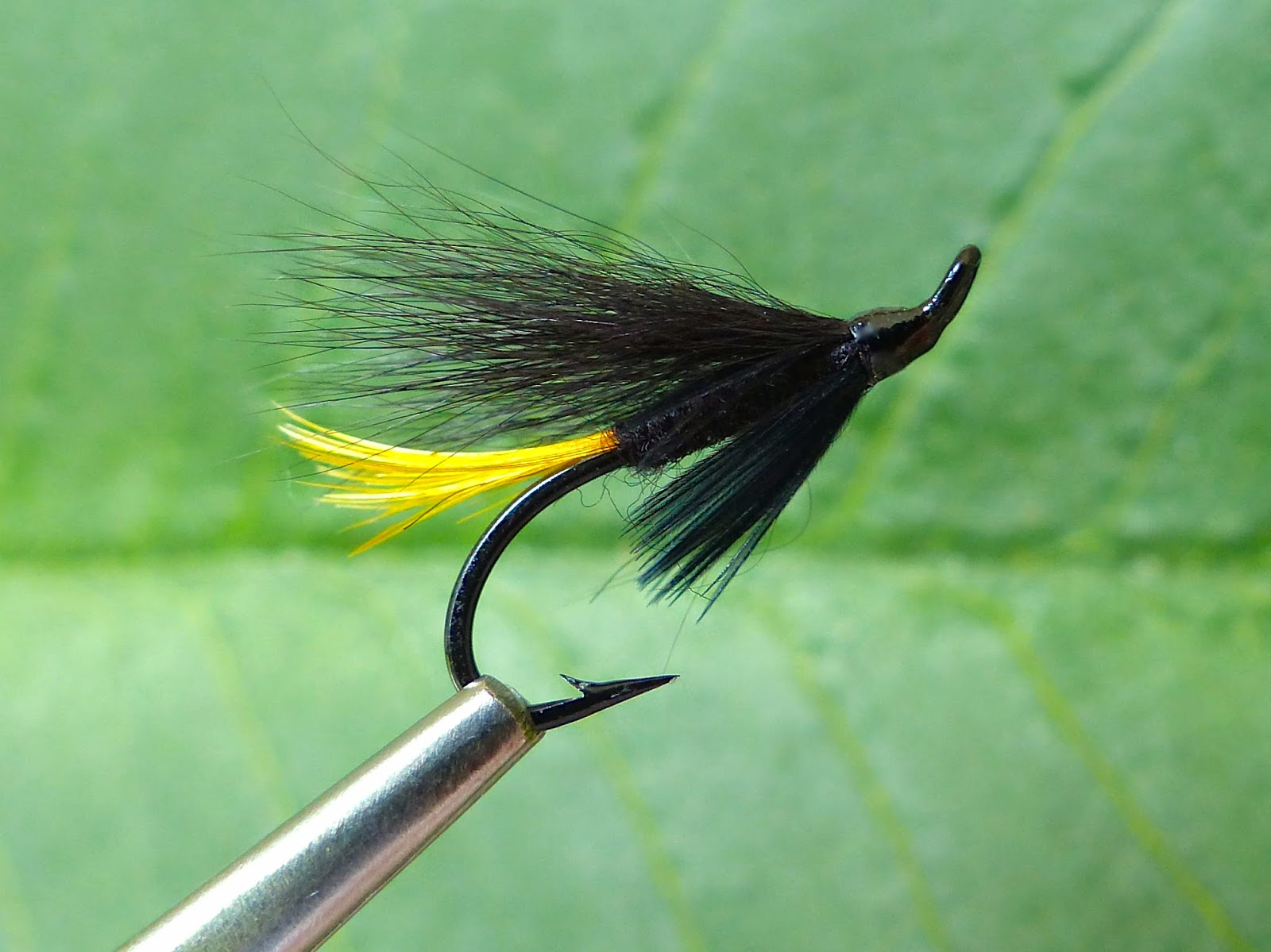
The "Pert'near," as it's known in some circles

Usually, I like to provide a little bit of history when I post fly patterns. I have nothing to say in the history department this time. I can't find any information about the origins online. The name of the fly is so generic, Google isn't even helpful. It's not in any salmon fly tying books I own. The only time I've seen it published was in an old W.W. Doak catalog. Maybe the Doaks still sell the Almost in their shop, but it's not listed in their online catalog. I have seen them for sale at Curtis Miramichi Outfitters and I'm fairly certain the fly has Miramichi roots. 

So why the name "Almost?" Is it because there's almost nothing to it? Is it because it's almost all black? Perhaps the name refers to the fact that it takes almost no time to tie? I could probably come up with plenty of guesses if none of those are correct.

In preparation for the upcoming Connecticut broodstock salmon season, I tied a few this afternoon. I have never tried fishing this fly any larger than a size 8. I carry them in sizes 8 to 12, with some tied very small on low water hooks. I've found a size 10 Almost to be the most effective, however. I fish it on a long leader and a light tippet, usually 6lb. test. I use it on both sunny and dark days. It's a very subtle, drab pattern, so it's a good choice when the fish are feeling spooky. 

Give it a shot sometime. It couldn't be much easier to tie. Its simplicity is almost an affront to a culture  accustomed to fishing overindulgent flies for fish who aren't even feeding. Regardless, it works! 


--------------------------------------------------

Almost

Hook: Any (pictured above: Partridge Code M sz. 10)
Tail: Golden pheasant crest
Body: Black wool
Wing: Black bear hair or squirrel tail*
Throat: Black hen 
Head: Black

*I use hair from a black-dyed fox mask for my small flies

Monday, August 4, 2014

Wedding Boutonniere Flies


A dapper angler

I was recently commissioned to tie fourteen wedding boutonniere flies for a couple who tyed the knot earlier this month. At first, I submitted a hairwing atlantic salmon fly design in the requested color scheme, pink and blue. The colors were a little off, so the groom sent me a picture of the tie that he and the other groomsmen will be wearing. It was a few different shades of blue with jumping tarpon and little pink tarpon-type flies.

It seemed silly to pair salmon flies with a tarpon tie, so I retied the prototype. The second pattern was a more pleasing design, loosely based on a Florida Keys tarpon fly template. Salmon fly boutonnieres look nice, but they can be a little two dimensional. With its palmered marabou and hackle, a tarpon fly looks more "floral" to me. 

Ready to party!

After a little more tweaking, the third time was the charm. I wish I could have tied them on conventional stainless saltwater hooks, but I could only find brooch pin hooks on modified streamer and salmon irons. Regardless, I like how they turned out.

I bought one extra brooch pin hook. I might tie fly boutonniere for myself one of these days. After wearing it, I figure I can cut it apart and retie one to match another outfit.

Wednesday, July 16, 2014

Monday, July 7, 2014

Quebec - June 30 -July 4, 2014: A Trip of Opposite Extremes

Sunrise over Les Escoumins


If I had to sum up this trip in one sentence, I’d probably say, “Mother nature had her way with me, but I persevered.” I think “barely persevered” would be a more accurate description. I’ll try to make a long story somewhat shorter…

Part I

This would be my first time fishing in Quebec. The trip started on the North Shore of the St. Lawrence River in the town of Les Escoumins, Quebec. The first destination was the Escoumins River. The Escoumins has a small run of salmon, but I’ve been told it’s a fairly predictable run. It was a chance to fish with my friend John again, this time on what he considers his “home river.”

After a long, hard winter, the last scenario I expected to see was low, warm water and with few fish in the river. Apparently, the Escoumins heats up quickly. The air temps were painfully hot and the river felt like bath water. You know it’s bad when our clothes were sweat soaked by 6:30am. The river was almost 70º at the start of the day. 


The falls at high tide


We fished the first pool on the river at high tide. The tide brought cool water in from the bay. Despite being a good tide, it didn’t bring salmon in with it. We decided to call it quits and head upriver to an impassible falls. We did see salmon upstream and some were large. The main problem was that the majority weren’t holding in areas that could be fished. They hung out in the well oxygenated water below the falls. Every once in a while we’d see one try to jump the falls in vain. 


Wet wading...a bad sign while atlantic salmon fishing

The forecast was just as bad for the next day. I was planning on fishing the Escoumins for two and a half days. I decided to cut my losses, book an earlier ferry trip across the St. Lawrence, and head to my next destination a day early. 

Part II

The next stop was the Gaspé Peninsula. It was a very nice ride. I passed many salmon rivers along the way. The highlight was seeing the legendary Restigouche River for the first time. 

I considered stopping at the Matapedia to fish the unlimited rod water for the afternoon, but I decided to drive past it (painful as that was). I was headed to a chalet on the Petite Cascsapedia to reunite with my first salmon fishing partners, Doug and Ray. They had won some November draws for the Petite and the Bonaventure, but had an open day mid-week. It would be great to be reunited on a salmon river after several years. 

I entered the 72 hour draw on the Grand Cascapedia and the 48 hours draws on both the Petite Cascapedia and the Bonaventure. I really wanted to fish the Grand. Besides being one of the world’s great big salmon rivers, it was the only one of the three that was actually fishing well. I didn’t win water on either the Grand or the Petite, unfortunately. 


Bonaventure - D Sector

It looked like I would be on the Bonaventure open water (C & D sectors) for the next five days. On the first day, I drove the entire length of D sector, stopping by almost every pool to scope out the unfamiliar water. To say the Bonaventure is visually stunning is an understatement. I’ve seen pictures and have heard about its crystal clear water for years, but seeing it in person is a whole different story. A common refrain goes something like, “Be careful where you wade. The water is so clear, you’ll think you’re stepping into a two foot hole and you’ll instantly be up too your chest in water.” It’s totally true and I made that mistake a few times. Unless I’m talking about the Bonnie, I’ll never use the term “gin clear” to describe a river ever again. I have fished some clear rivers in the past, but nothing comes close to this. 

I saw some great looking pools, but many should be fished from the far side of the river. Unlike the Escoumins, the water on the Bonaventure was relatively high and cold. Wading across would not be an option. Sight fishing for salmon, which is the Bonaventure’s big draw, wasn't really an option, either. I would have loved to fish dry flies to spotted fish, but conditions were more conducive to covering water with wet flies. 


Too high to cross, even in the riffles.

An even tougher pill to swallow…the runs on the Bonnie have been horrible this year. The multi sea-winter salmon have largely been absent so far this season. The place was a bit of a ghost town. At least it kept angling pressure down, I guess. 

I have to admit, I was starting to panic a bit. I tried to relax and continued checking out the pools. The first pool produced nothing and was clearly not a good pool to fish in high water. The second pool, however, looked promising. 


The money pool...at least for me it was.

I knew that the grilse were starting to show up, so I went with a #4 white tailed Green Machine. It’s been good to me when there were grilse about. It was a good decision. I hooked into a 6lb. grilse on my first pass through the pool. This pool was tricky one to fish and wade. The grilse went berserk from the minute it was hooked. He sped downstream and ran directly underneath a row of overhanging trees. I managed to keep a tight line to him and, after a little chase downstream, landed him safely. He was probably the best looking and hardest fighting grilse I’ve ever caught. Unfortunately, he was kind of crazy and it was impossible to get a picture of him. I was relieved to be on the board on my first day fishing the Bonaventure…and on my birthday, no less! 

Ray on a nice C Sector pool


The next day, Doug, Ray and I fished C and D Sector together. It was great to be reunited with my old friends. The only action any of us had was in the first pool we fished. Doug pricked a salmon, but couldn’t get him to come back. I had one roll in front of me while I was fishing the lower end of the pool. I worked the rise with a Bomber for a while but, because of the rotation, I had to move on and leave the fish. 


I was on my own again on day three. We had gotten some heavy rain overnight. The river was a little higher than the day before, but still crystal clear. I went back to the same pool in which I caught the grilse and promptly hooked into another. This time, the fly was a #4 Blue Charm (Mike Crosby style). Despite having fished one for years, I’ve never had any luck with a Blue Charm before. This grilse was the opposite of the first. He really didn’t fight at all. I pretty much reeled him right in. He went berserk when I tried to take the hook out of his mouth though. I probably shouldn’t have been surprised…weird trip, weird fish. 


Grilse w/Mike Crosby style Blue Charm

That would be the last of my action for the trip. I could tell the river was coming up and my window for good fishing was pretty much over. Once again, I decided to cut my losses and get back on the road earlier than planned. Hurricane Arthur was ripping through New England and on its way for eastern Canada. It was a good call. The Bonnie was blown out by the next day, trees came down and I heard the whole Peninsula lost power. 

———————————————————

I certainly wouldn't have refused a canoe ride

The Escoumins was too low and hot. The Bonaventure was cold, higher than normal, and rising. There should have been a lot more fish in the Bonnie, but they just weren’t there. The Bonnie has a good ratio of salmon to grilse, but all I caught was grilse. One fought as hard as any grilse I’ve ever hooked and the other fought worse than any salmon I’ve ever hooked. I thought I would catch fish on the Escoumins and run the risk of getting skunked on the Bonnie. I probably did more driving than fishing on this trip. It was truly a trip of opposite extremes. 

If ever there was a trip to get skunked, this would have been the one. It didn’t happen though. I didn’t hook up with any msw salmon, but at least I had my pair of grilse. Two fish landed in two and a half days of fishing on the Bonaventure actually isn’t bad. Yet another skunking narrowly averted!


Time to head home


Tuesday, June 17, 2014

Anticipation

Brûlé McSprats (sz. 3, 5 & 7)

This is one of my favorite times of year. North American salmon fishermen reconnect with one another. Whether it's by phone, email or even SMS, anglers ask each other, "Where are you going this year and when?" This is the time of year we start to lose sleep thinking about river conditions, run timing and about flies we don't need, but feel compelled to tie anyhow. Some of my friends have already put time in on salmon rivers, most with little to show for it. "Things are late this year" is a common refrain this season.  I'm just starting to lose sleep, hoping that I'll hit it just right. Good luck, friends!

Wednesday, May 28, 2014

The Fly is the Key - Guideline/Mikael Frödin


If you haven't seen them already, Swedish tackle manufacturer Guideline and innovative fly tyer Mikael Frödin regularly publish helpful salmon fishing tutorials on their YouTube channel. Being a fly tying junkie, the most recent video, "The Fly is the Key," is my favorite so far. Frödin discusses which attributes help make a salmon fly successful in different conditions and types of water.

Turbo Bombers...I can't wait to tie and fish these

I love the cutting edge fly designs of the current crop of progressive Scandinavian tyers. Their flies are so much different from what we typically use in North America, but I think there is a lot of potential for cross-pollination. Speaking of North American/Scandinavian cross-pollination, the fly that really caught my eye was the Turbo Bomber...wow!! As a big Gartside Gurgler fan, the Turbo Bomber is right up my alley. Time to order some turbo discs...

Friday, May 16, 2014

A Good Way to Kill Some Time

It's finally my turn to catch with the Samurai Dog

Spring took an awfully long time to get here. So did the fish. Some still aren't here. For instance, the small, early run of sea run brown trout is nowhere to be found. I caught my first two years, one month and a day ago. The key part of the last sentence is "one month ago." Granted, spring of 2012 was as early as spring of 2014 is late, but I'm getting impatient!

While I wait for the browns to move up from Long Island Sound, I've decided to forgo fishing for resident trout in favor of swinging flies for striped bass. This is the first season I've fished for stripers with a two handed rod. I went out twice this week and finally had the opportunity to fish the Samurai Dog tube fly. My customer hasn't taken his Samurai Dog off in three weeks of fishing, landing trout in the Farmington and Westfield Rivers and striped bass and smallmouth bass in the Connecticut River. I just delivered another order to him last night, one which wiped me out of small turbo cones (more on order from the Canadian Tube Fly Company). 

Both trips this week were more brief than I would have liked, but this is a crazy month for both work and family obligations. Still, I caught fish on both occasions. 

Who doesn't like the Sunray Shadow? 

Tuesday evening, I landed my first striper of the year on a small Sunray Shadow tied on an aluminum tube. It was also my first striper on a two handed rod. The fly was a small one, around 2.5" in total length. It's diminutive size didn't stop the "barely legal" striper from hammering it nonetheless. It was a healthy, thick fish, which measured exactly 28" (legal size for retention). I planned on keeping it but, after verifying the fish's length and removing the badly mangled treble hook from its lips, I reconsidered. The possible after-effects of a late night and an early morning were too much for me. You win this time, buddy...and the fish swam free. A little later that evening, I caught a small schoolie striper on the Samurai Dog. It was fun and productive couple of hours on the water. 

One benefit of tube flies...even though the hook
was badly mangled, the fly was totally unharmed. 

Last night, I had more time, but there was less action overall. For a short period of time, the stripers were active just under the surface. I could see their backs break the surface of the water. I nailed another schoolie on the Samurai Dog, but the bite shut off pretty quickly after that. Oh well, it beats getting skunked. 

Fortunately, I was able to get the obligatory "fly-in-mouth" pic. I've been told that no one believes a new fly actually works without plenty of in-action closeups (*eye roll*). Fortunately, my customer had the courage to be the "guinea pig" and it really seems to have paid off for him. 

I'm nervously waiting. The aforementioned trout should appear any day now. However, if the weather forecast is accurate, heavy rainfall might mess things up. "Rain...bad for the fishermen, good for the fish," as they say. Hopefully I'll be able to fish for them. It's the most finicky game in town, but I'll trade the abundance of springtime hatches and resident trout for it any day. I'm perfectly content killing time with stripers, though.