Wednesday, February 29, 2012

Russia Bound!

Destination: Kola River

Well, today I booked my flight to Moscow for my first European salmon fishing trip! I'm going with my buddy John, who travels to the Kola peninsula every other year. We'll be fishing the Kola river, primarily. We're headed there the very beginning of June, which I hear is prime time for very large salmon. Even though the trip is just a few short months away, the reality has yet to sink in for me (despite tying tons of flies for the trip during the past week or two). I'm sure time will tick faster once spring is officially here. I'm in no hurry, however. I still have plenty more flies to tie and I need to spend plenty of time on the water, practice casting sinking Scandi heads and large tube flies on a 15' rod. Considering the preparation I'll need in order to fish close to my "top form," this might be a short trout fishing season for me, at least in the beginning. I'm looking forward to a future blog post loaded with torpedoes!

Tuesday, February 28, 2012

Ted Williams and the Atlantic Salmon

Ted Williams and the Atlantic Salmon from Martin Pitts on Vimeo.

Ally's Shrimps

Ally's Shrimps on copper/aluminum tubes and doubles

In my experience, Ally's Shrimp is a great fly early and late in the season. My first salmon of last season was caught on a #1 Ally's Shrimp, tied on a single hook. This is my first attempt at tying it on a tube. I subbed natural Finn Raccoon tail for the normally prescribed grey squirrel tail on the tube versions. I've also had great success swinging this fly for trout all season long, particularly rainbow trout. I tie it on a stonefly hook in sizes #10-#12. 

Ally's Shrimp for trout


Friday, February 10, 2012

More Cascades

A Cascade Parade

This should be enough...on to Snaeldas and Willie Gunns...

Friday, February 3, 2012

Cascade Tubes

These two will turn my luck around!

The Cascade is one of Ally Gowans' most famous and effective patterns. Tied in all sizes, and on both hooks and tubes, it is considered a modern classic. It's probably the most effective pattern with which I have yet to move a fish. I keep fishing it because I know thousands of angler and fish can't be wrong. As a devoted streamer fisherman for trout, the same is true of John Barr's Slumpbuster which, ironically for me, only seems to further any slump I happen to find myself in. I don't know about the Slumpbuster, but these Cascades are finally going to work for me this season. Tied at a total length of about 2.75", they should be just right for June on the Kola River. If they don't work there, I'm going to take the whole lot of them and throw them into the river, where they will all promptly hook salmon, I'm sure...

Monday, January 23, 2012

The Champion 5/0

The Champion-a formidable opponent

To the fly tyer not yet initiated and/or experienced in tying classic Atlantic salmon flies, Kelson's Champion probably doesn't look all that much different from the myriad of similar classic patterns. In fact, flashier flies like the Popham or the Jock Scott probably look more difficult to dress than the Champion. Don't let its relatively simple body construction fool you, however. The Champion has one of the toughest winging arrangements in all of classic salmon fly tying. In fact, I consider this one of the most difficult flies to dress of any, regardless of style or intended species (of known/established patterns). 

The difficulties really begin with the wood duck underwing. Because of its stem structure, wood duck is extremely difficult to set directly atop and parallel to the hook shank (when tied in by the stems, not by compressing the barbs of the feather). To practice the technique, the day before, I tied the Tomah-Jo, a Mary Orvis Marbury lake/bass fly. 

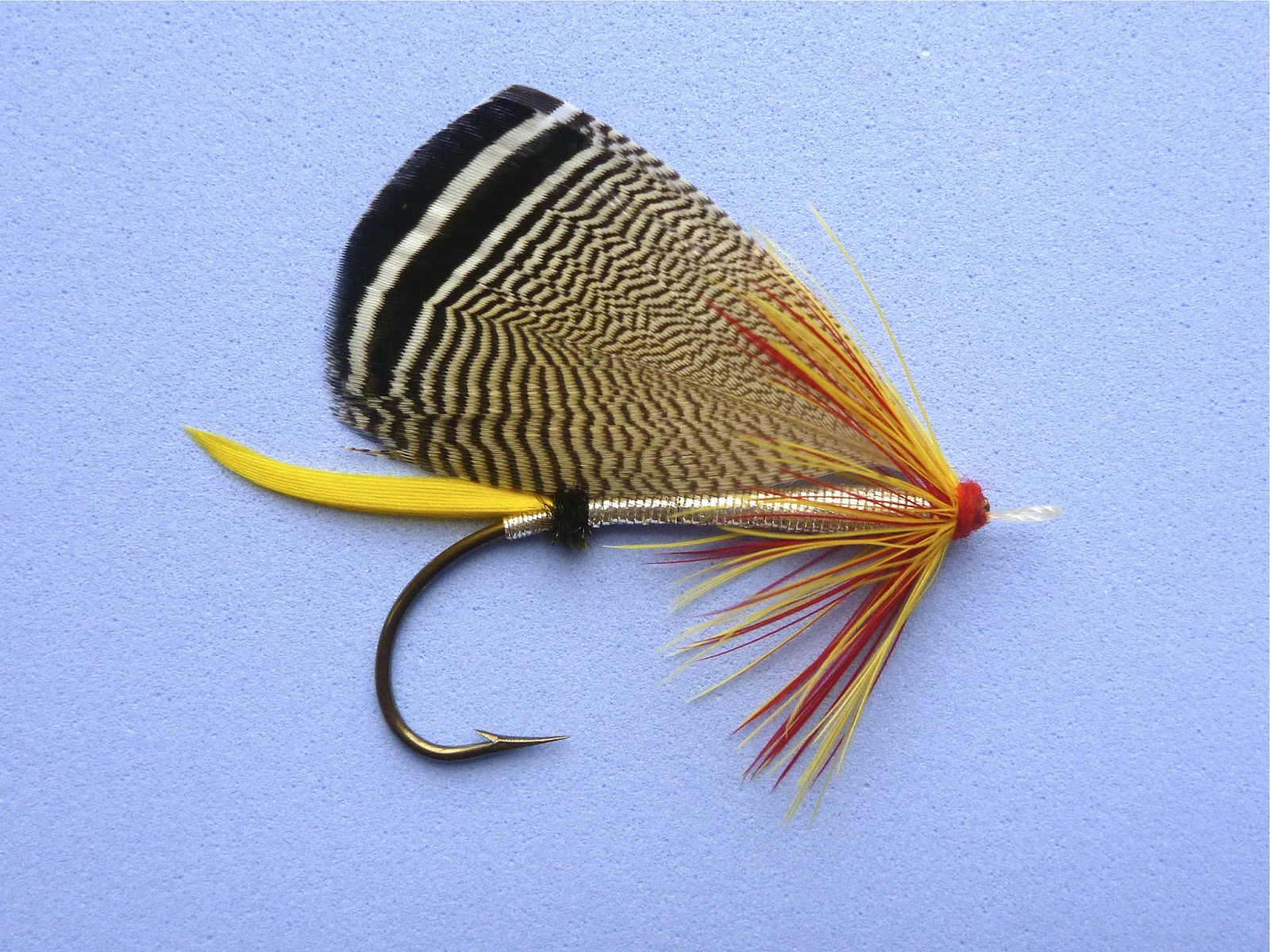
Tomah-Jo 3/0, as interpreted by Rossman/Boyer

The Tomah-Jo was my first attempt at tying full wood duck wings. I had no guide to go by, which was probably turned out to be a good thing in this case. As such, I kind of stumbled on a method of mounting the wood duck feathers which, as far as I know, is at least partially unique. I might document the method in a later blog post if I can get a good photo set up at my tying desk. Anyhow, successfully tying Tomah-Jo gave me the confidence to move on to the Champion.

Adding to the Champion's ornery nature is the individual application of later wing components. The married strips are added in small sets instead of all at once. One regret I have is that I did not marry the teal into the wing. My teal was too short for a fly this size. 

This was my first stab at the Champion. I tied it mostly from memory of Kelson's plate in "Land and Water". I do not own the book, so some things wound up being a little different than the original. If there is a next time around, I am going to tie this fly smaller and follow the "Land and Water" instructions as closely as possible. 

In all, I am very happy with the results, especially considering how large it is. I am no longer intimidated by stem-mounted wood duck wings. In fact, I'm looking forward to the next one. It was a pretty good way to spend a snowy weekend.