Showing posts with label fishing technique. Show all posts

Monday, January 4, 2021

Ten Tips for CT Salmon Anglers

A nice male, caught in an under-fished location


Since I took 2019 off from guiding, rarely fished, and largely checked out of what was happening in and around the CT salmon fishing scene, I sort of forgot about how others choose to navigate this fishery. I never forgot how I did things. It came back immediately in 2020. If anything, I found myself thinking more clearly than ever. I fished relatively few flies, but picked them with greater thought. I wasted very little time. If I wanted to use a "novelty fly," I did so on my first pass, when an aggressive salmon would be most likely to take it. If that didn't work, I chose something more "sensible" for the next pass. This fall, the salmon were a little crankier than usual and this season hammered home some important lessons. I know some folks are still struggling to hook up, so I will share a few of these lessons here. 

1. Efficiency is KING 

Every cast has to count. Every cast has to be your best. Every cast has to fish as perfectly as possible. That doesn't mean that you must be able to cast a country mile, but the ability to do so doesn't hurt. Practice casting, but not while you're fishing. Fishing requires a different type of focus than does casting practice. One will suffer if they are done simultaneously. Practice casting in the wind. Practice casting with obstructions. Practice all of that so, when you're actually FISHING, you are making the most of your time by casting as well as possible. When every cast counts, you'll be fishing as efficiently as possible and you will make the most of your day. 

2. Never stop moving 

Move all day long. Don't stop. Unless you're working a fish, don't stand in the same spot for more than two casts. Cover as much water as possible. If a pool doesn't produce, get out of there. Unless you find takers, fish as many pools as possible in the course of an outing. Don't forget to try the water on the margins. You just might find your new honey hole. 

3. The fly doesn't matter 

The fly doesn't really matter. I like to tie, so I have a lot of flies. But I could get by with far fewer. I just need a couple flies for surface fishing, a couple for just under the surface, a couple long and/or heavy tubes, a couple flies for high/dirty water, a fly for low/clear water and a change-of-pace fly or two. Even within that list, I can think of patterns that would do double duty. 

4. Choose your fly with care 

I know I just said the fly doesn't matter. However, some flies are better suited to this purpose than others, and those are the flies I want to have. For example, when the water gets cold, salmon don't take as hard, don't always turn on the fly, and don't often get hooked in the corner of the jaw. For that reason, I use tube flies with a hook that rides behind the materials. People ask if our salmon eat woolly buggers. Of course they do...but I wouldn't be caught dead using a long tailed fly in 36ยบ water. When the salmon takes soft, I want to make sure he gets 100% of the hook in his mouth since I know hooksets are inherently dicey at this time of year. I have specific flies for specific sets of conditions. When they fish are acting recklessly, anything will work. For the majority of the time, I am looking for a fly that will make the most of the conditions at hand, be it water height, temperature, clarity, the amount of sun of the water, etc. 

5. Choose your fly line with care 

Like my fly, I choose my line according to conditions. Unless the water is low enough for me to fish a single handed rod and a floating line, I use a short two handed rod and Scandinavian shooting heads. The bulk of my salmon are caught with a floating head, but I have different densities of head at the ready. Need to fish a fly slowly through heavy chop? A fast sinking tip will get your fly down, but the floating head will still be fishing at the same speed as the surface of the water. Fully sinking heads are the best option for slowing the fly down in a situation like this. 

6. Look for aggressive fish 

This is relative of tip #2. Unless you find a bunch of eager salmon, keep looking for that one aggressive fish. Look for him up and down the river if you have to. Then, once you find and either land or lose him, look for the next aggressive fish. It's ok to spend a little more time on historically productive lies, but don't put all of your eggs into one basket. Keep moving until you find that fish.

7. Don't waste your time in less productive water 

Sure, you might see a salmon jump across the river, in the frog water. Just leave it alone. The cruising fish are hard to pin down and hard to hook reliably. Fish the runs and let the spin fishermen take the frog water. Sure, you might not be casting over every single fish in a pool but, chances are, you'll be fishing over those you're more likely to hook and land on a fly. Plus, you can work through moving water much faster than still water, which brings us back to the ever-important tip #2. If you know some reliable frog water spots, that's a different story. 

8. Wait until you feel the weight of the salmon to set the hook

This is an oft repeated piece of advice. When fishing subsurface, don't trout set or you'll risk pull the fly from its mouth. Slow down. Set the hook when you feel the fish on. Let the salmon do most of the work for you, then smoothly raise the rod. If you use tube flies, there is no need to drive a thick salmon iron into their jaws with a Jimmy Houstonesque hook set. The exception is when stripping flies....(strip) strike first, (strip) strike hard, no mercy, sir! I often strip with two hands so I can remain in contact with the fly at all times. The worst is when the fish takes at the end of the strip and you run out of line to tighten. 

9. The fish moves when it's fighting. Why don't you? 

This one should need no further explantation, yet it does...over and over again. The fish is constantly trying to get a better position on you. Why the hell would you stand in one place and let it? After the fish is hooked, as long as it can't be stripped right to hand, reposition yourself to make the fish work for every inch of line it takes. Boxing isn't just punching. It's mostly footwork. Don't stand still and let the fish pummel you. Keep moving and take back the upper hand. 

10. Put the wood to 'em! 

This is an offshoot of the previous tip. When it comes to fighting larger and/or tougher fish, they will battle to a stalemate if they can. Meanwhile, the hook is getting looser and looser until either you get lucky or the fish does. Put some pressure on that fish. Keep him off balance. Keep pulling the hook into his mouth, not away from his mouth. That's a big one, so I will repeat it. If you're pulling directly upstream on a fish that is directly downstream from you, you will be pulling the fly towards you and away from the fish. By pulling the fly into his mouth, you will be exerting maximum pressure. Then, when he runs, you ease off the pressure. As soon as he stops, put the pressure back on immediately. At some point, either you will end the fight or the fish will. And, if you mess around for too long, you might get lucky, but kill the fish. So play them smart and play them hard. 

*BONUS TIPS*

-Never be afraid to experiment. Sometimes it works and becomes a part of your repertoire. 

-STAY POSITIVE!! I can't overemphasize this! 

-Read books. Read this blog, too. Read anything and everything, regardless of media type. Listen to podcasts. Be an information sponge. Facebook, Instagram and YouTube are great, but solid fishing strategy existed long before color photography, videos, etc. Books...they aren't just for geezers and nerds. It takes actual work to write a book. Yes, you will find some that are a bit suspect, but if someone cares enough about salmon fishing to write a book about it, you can probably learn something from it. No one does it for the money. 

Feel free to comment below...compliments or criticism, either is fine with me. Add some tips of your own, if you're so inclined. I still have a lot to learn. 


Monday, September 11, 2017

Connecticut Broodstock Atlantic Salmon Season: One Hand or Two?


Top: Sage z-Axis 11' 6wt switch rod
Bottom: Orvis Hydros 9'6" 6wt

     When I am guiding, particulairly in the early season, I'm often asked whether a single or double handed rod is appropriate. Before this four year stretch of low water, the answer was easy. Either are fine. It seems like 2017-2018 might be more like a typical year in terms of water levels. Despite having great success in low water,  I'm anxious about getting back to the way it used to be. I miss using the two handed rod in the early season, even if the fish are spread out over a much greater area. 

    During the past several years, I have focused on the lower Naugatuck River, which can be an excellent place to fish either a one to two handed rod throughout the season. I don't recommend a two handed rod for fishing the upper Naugatuck. The river is too narrow. However, single handed spey can come in handy up there. Like the lower Naugatuck, the Shetucket River can go either way. In general, it's wider than the lower Naugatuck, but with a more gentle current. The tips below mainly reflect my experience on the lower Naugatuck, but can be tweaked and applied to the other two salmon fishing areas in Connecticut. 


When to use a Single Handed Fly Rod

     The single handed fly rod is my tool of choice in the early season when the river is at a low-to-normal level. The lower Naugatuck doesn't have bank to bank current, so I think of fishing the runs as fishing a "river within a river." This can be more like small stream angling in that the run might only be 10-25 feet across. Long casts are usually not necessary. The only place where casting gets difficult is where the narrow band current follows the near bank. In this case, single handed spey casts or cack handed casting may be necessary due to the tree-lined banks.

     I like to target the inside and outside seams. Because the water flow is so weak in low water, the fly often has to be animated instead of simply swung through the run. A lot of strikes come when stripping the fly back along the inside seam. Because of this, dealing with running line and a shooting head can be a pain in the neck (more on that later). I have hooked salmon with my mono leader almost inside the tip of the guides. If nothing takes, just shake out some fly line and recast.

    Stripping a fly through slow water can be very effective. I prefer a smooth retrieve, be it fast or slow. I don't let the fly pause. Often times, I place my rod under my right arm and strip with two hands, even when fishing a fly slowly. I can feel as soon as the fish strikes. As opposed to waiting a moment to set the hook, like with a swung fly, I tend to tighten up right away when stripping with both hands. I find a more proactive approach gets a stronger hookset in very slow water. In any case, I find this type of fishing easier with a single handed fly rod.

     If I expect to fish dry flies, I will usually bring a single handed rod, though I fish them on the two hander now and then. I think I am more accurate with a single handed rod. When fishing dries, I mainly fish to known lies or spotted fish, so I want the fly to land exactly where I want it to land.

     My single handed rods of choice are an Orvis Hydros 9'6" 6wt and a Sage One 9' 7wt. If I had to pick one, it would be the latter. The heaviest I go is 8 wt., but it is rare I use it since I don't often fish large, heavy flies with a single handed fly rod.


A two handed set up for high, colored water...intermediate Scandi head,
7.0 ips Versileader, and a big tube fly


When to use a Two Handed Fly Rod

     When the water is right for swinging a fly, I'd much rather use a two handed rod than a single hander. A lot of anglers think it's for distance casting. It does cast further more easily, that's for sure, but it's not my main reason for using a two hander. The banks are lined with trees and can be steep. Backcast room can be limited to virtually non-existent. In this scenario, the two handed rod is definitely superior.

     In higher water, the current still isn't bank to bank. Again, I like to fish the inside and outside seams, but I have to reach further to do it. I also have to control a longer length of line. A longer rod makes it easier to do both. In very high water, there will be some fish lying close to the bank. Either a single or double hand rod will work, but I prefer the versatility of the double.

     Except in really high water, our rivers aren't really good places for traditional spey lines. We just don't need that much distance. Most of my fish are caught with modest length casts, not Hail Marys. As such, shooting heads are good choices. Either a Skagit or Scandi head will work, though I prefer the Scandi setup.

     Most of the time, I'm not throwing a heavy fly. The Scandi system delivers a fly with more delicacy. Also, the airborne anchor creates less disturbance on the surface of the water. One common mistake I see, most often with Skagit casters, is laying the line right over the run and ripping the anchor through water that might hold fish. With an airborne anchor (such as with the single spey or snake roll), the anchor will happen behind or alongside the angler, where fish aren't as likely to hold.

     As the season rolls on, it might be necessary to fish a fly deeper and slower. I used to use floating heads and polyleaders. Now, I find multiple density heads more effective, especially when it comes to slowing a fly down. Both Scientific Anglers and Rio make multi density heads. Guideline makes great heads, too, but they are hard to find in the US. A good selection of shooting heads would include a full floater, float/hover/intermediate (F/H/I), hover, intermediate, S3 (H/I/S3), and intermediate/S3/S5 (I/S3/S5). I don't use the I/S3/S4 much, as these rivers don't have heavy enough current to justify its use. I have it in case I need it, though. Of course, single handed sinking lines can be used on single handed rods, but I find it easier to extract the line from the water with a two handed rod than with a short single hander.

     I don't fish too long of a rod here in Connecticut. I don't often need extreme distance. My early season two hander of choice is a Sage Z-Axis 11' 6wt. I like to use a 325-350 grain Scandi head with this rod (floating). When I need a little more power, I use a different rod. This year, I'll be using a Sage TCX 11'9" 6wt. It prefers lines in the 374-425 grain range. This is the rod I use with sinking heads and when I need to cast a larger fly or throw a bit longer line. If I really need to cast far, I use a 12'6"-13' rod, but nothing longer than that.


------------------------------------

High water salmon....lower Naugy @ 1000cfs
Time for a longer rod, this time a 13 footer

     Regardless of water levels, I always travel with both single and double handed rods. When the river is at that sort of "in between"level, I might use either, or even both, depending on the pool. Be prepared. It's better to have it and not use it, then to need it and not have it. A lot of anglers so desperately want to use the two handed rod that they neglect the effectiveness of the single hander in certain conditions. For me, the job is fun, regardless of the tools needed. 


Monday, January 23, 2017

American Shad Flies - Part II: Flies, Darts, and Data


Handful of shad soft hackles (sz. 8-10)

     In Part I of this short series, I demonstrated how to tie my standard, bread and butter shad fly. It is a simple, effective, and easy to tie pattern. In addition to that fly, I have a few other patterns I like to use. However, before I describe the others, let's take a look at some shard darts, the standard lure used for American shad fishing.


A seclection of Eagle Claw shad darts in common color schemes

     Shad darts and willow leaf spoons are the most widely used lures for American shad fishing. While willow leaves have no relation to flies, most darts involve a small degree of fly tying technique. Many traditional darts have a contrasting color scheme which can be easily replicated when tying shad flies. Darts, most often made with lead, can vary greatly in weight, from 1/64 oz up to 3/4 oz or more. The smallest darts can be used with a fly rod. The largest darts can put a hole in someone's head!
   

Mike Taylor shad dart

     In addition to being a great fisherman, my friend Mike Taylor ties some excellent tin (non-toxic) shad darts. The dart pictured above is tied in form of a traditional dart, but with some modern touches, such as Krystal Flash and glitter paint. Mike's darts are well constructed and very durable. Most importantly, they are excellent fish catchers. Notice how Mike's darts are tied on light wire, gold jig hooks.

Mike's "no frills" mini darts

     Mike gave me a couple of his mini darts last season when I needed to get down quickly. The red one (pictured above) caught a shad on its first cast. With no additional materials to slow down their descent, these mini darts are great sinkers. They also work well when shad nip at the back end of a traditional dart or long-tailed fly. This type of dart could easily be converted to a fly by using tungsten cone headsand tiny bit of material to hold it in place. A more esoteric option would be to use undressed bottle tubes, such as Shumakov Long Range or Skittle tubes.

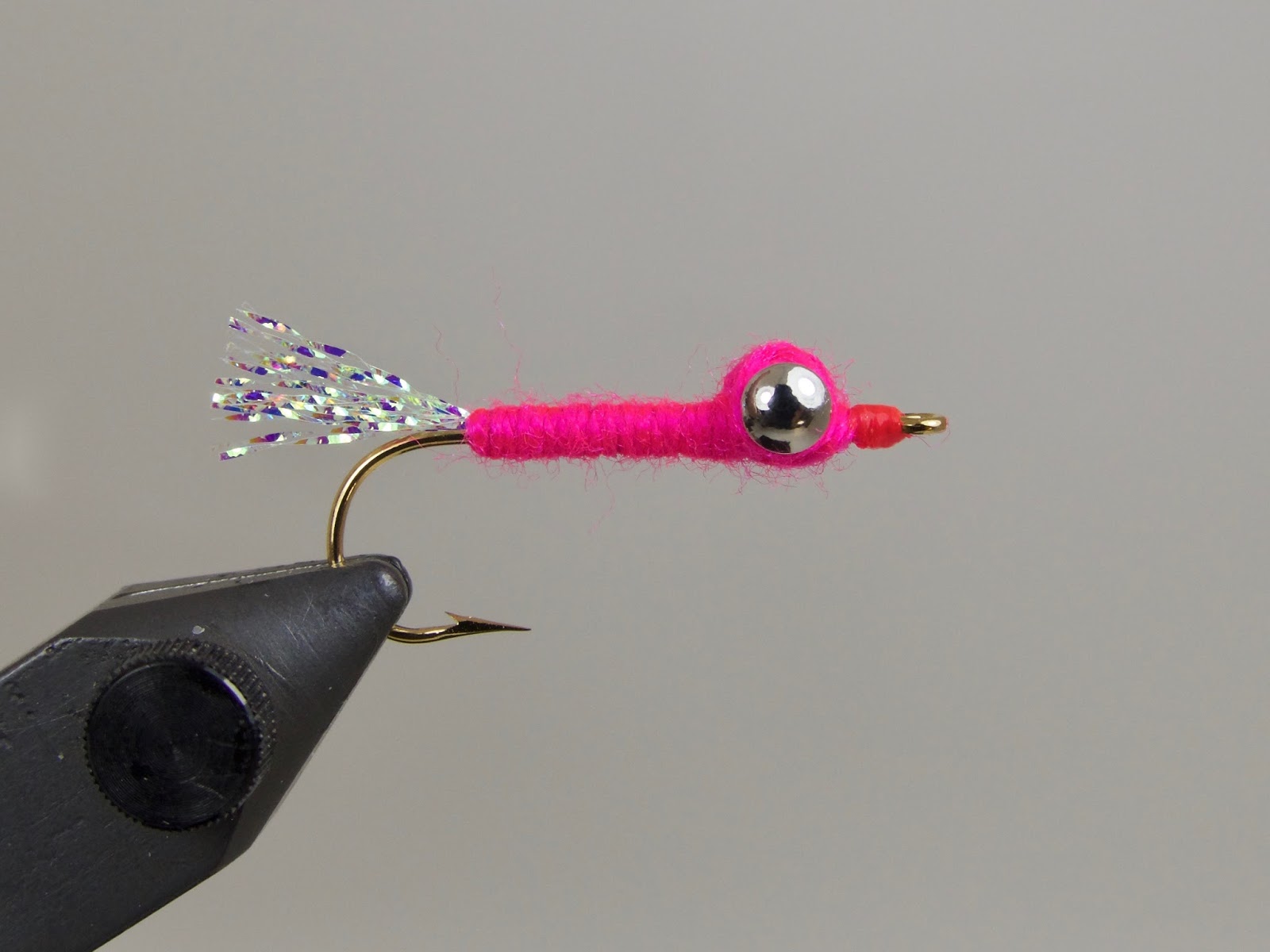
My standard, bread and butter shad fly

     The pink fly above is my basic pattern. This was the pattern shown in last week's step-by-step tutorial. My favorite colors are fluorescent orange, pink, green, blue, and red. They can be tied in bulk in next to no time at all.

The bread and butter fly, tied "low water" style

     Sometimes shad get "nippy," grabbing onto the rearmost part of a fly or dart. This happens often near the end of the run. It can also happen during severe weather/pressure changes. When shad refuse to commit, I switch to a pattern tied in the Atlantic salmon "low water" style. Basically, I tie a fly one size smaller than the hook I am using. In the picture above, I tied a size 6 fly on a a size 4 hook. I usually tie a short tail. In this case, the tail doesn't even extend past the bend of the hook. I haven't tried omitting the tail entirely but, if Mike's mini darts work, I don't see why a tailless fly would not.

     Another option is to trim the tail on flies and darts. If possible, cut the material back to a point shy of the hook bend. Even if the shad doesn't grab onto the whole fly, hopefully it will get the business end of the hook in its mouth. Sometimes shad absolutely cream a fly, sometimes you'll barely know a fish is on. Be aware of those little taps.

UV resin shad fly

     When I want a tiny bit of extra weight, I use a fly coated with Solarez UV cured resin. Honestly, until I weighed the flies, I thought the resin added more weight than it actually does (refer to the table below). It's sort of like going up one size of brass eyes without actually going up one size. I'm not sure it makes that much of a difference. This fly takes about twice as long to tie as my standard pattern. Despite the extra work, the blue version of this fly was an absolute killer for me last season, so now I'm afraid not to have some with me at all times. 

    This is essentially the same fly as the one posted in last week's tutorial other than the body. Instead of wool yarn, I make a tapered underbody with Uni-Stretch, then wrap over it with Veevus holographic tinsel. The tinsel is slippery, so wrap carefully and under sufficient tension. After whip finishing, apply a coat of UV cured resin to the entire fly. I coat it all the way up to the head.

Beadhead shad soft hackle

     When the water is low, the fish are heavily pressured, or both, I opt for a small bead head soft hackle wet fly. This fly has been very good to me. The toughest, most memorable shad I ever hooked was caught on the pink and yellow wet fly pictured above. Though I tie these on standard wet fly hooks, I would like to try the jig-style nymph hooks to keep the hook point riding up. Here is the dressing:

Bead Head Shad Soft Hackle

Hook: Mustad 3399A or equivalent (sz. 8-10)
Bead: Brass or tungsten (1/8"-5/32")
Weight: Non-toxic wire
Tail: Hackle fibers or Krystal Flash
Body: Fluorescent wool yarn
Thorax: Ice Dub (to match tail)
Hackle: Hen neck (to match tail)
Head: Ice Dub (to match tail)

Favorite color combinations (body/hackle): pink/yellow, orange/green, orange/yellow, green/darker green

Tandem rig, the top fly a variation on the basic pattern (chenille head)

     I have been using sinking Scandi heads to get my flies down and to help keep them in the zone longer. It has worked really well so far. However, there are times when I prefer to fish with a single handed rod, floating line, and mono leader. When I feel like I need more weight to get down with that rig, I use a long leader and two heavy flies. This has gotten me into the zone and into fish when one fly just wasn't cutting it. Tandem rigs are also good to see if the shad are keying in on one particular color or size of fly. I've had great success with the combo pictured above. I the larger fly seems to get the smaller fly into the strike zone. Some shad take the big fly, but most seem to grab the soft hackle. 


Size/weight chart for the flies featured in this post (click to enlarge)

     Sometimes I get curious about how much flies weigh, so I use my handy little scale. I weighed all the flies and darts featured in this post (with the exception of the Eagle Claw darts). I prefer to weigh in grams since it's easier to compare light weight flies than when using ounces. As stated above, I was surprised how little weight the UV cured resin added to the fly, though purely by coincidence, it moved proportionally with the increase in brass eye sizes. It also weighed slightly more than my heaviest dart, which also surprised me. Some flies were too light to register on my scale,  but I don't concern myself with weight when I'm fishing flies that small.

     Besides the non-toxic wire used on the soft hackles, the only metal I used was brass. Tungsten would make for much heavier flies. Heavier flies might require using heavier tackle, which might make a 2-6 lb fish less fun to catch. Overall, I am happy with the size and weights of these flies, particularly when sinking lines, heads, and tips get the flies down well enough. 

------------------------------------------------------

     I hope this post helps some of you. Shad are an often overlooked local gamefish. If you tied a fresh American shad and a comparably sized trout tail to tail, the shad would drown the trout in a heartbeat. Fighting a big, tough roe shad can be very exciting, especially on appropriately sized fly tackle. Give it a shot this spring! 
     

Looking forward to spring...

Monday, December 12, 2016

Them's Fightin' Words! - 7 Fish Fighting Tips


The three slashes represent 32nd notes, you big dummy. 


 Around the time I began teaching drum lessons, one of my favorite students was a middle aged school teacher. She was a beginning drummer, but a very enthusiastic student. We worked through the material in Breeze Easy vol. I, which is the drumming equivalent of learning how to tie a Woolly Bugger. One day, she asked me a very basic question about drum roll notation. It was something I had known how to play for many years, but never considered the theory behind how it was written.

     "Is it notated this way because,..?" she asked.

     "Uh...yes, exactly," I replied. What I was actually thinking was, "Wow, I never thought of that before. It makes total sense! How could I miss that? I'm a conservatory-trained musician...how embarrassing!" A few minutes later, I said all of this out loud and we had a good laugh.

     Besides the notation tidbit I learned that day, I learned another important lesson. Teaching is a two-way street. The teacher often learns as much as the student. I had heard it said before, but that was the first time I experienced it myself.

     When I guide anglers, I try to focus on education. Often times, I learn as much as they do. In my experience, fish fighting technique is one of the more difficult things to teach. First, the angler must remain calm immediately after the excitement of the hookup. I try to explain the basics before a fish is hooked, then gently reinforce the points throughout the fight. Trying to coach someone while a fish is going bananas isn't easy, though. Over the past few years, I've noticed some technical areas which can be improved upon, resulting in more fish landed and safer releases for the fish. The following tips pertain mainly to freshwater fishing in rivers.


Henrik Mortensen displays several of the fish fighting tips below


Tip #1: The Game Plan

     Before fishing a run, pool, etc., form a fish fighting/landing game plan. It can be hard to think clearly with a big, strong, leaping fish at the end of the line. It pays to scope out the area to find suitable spots from which to fight and land fish. This is especially important when fishing solo. Once the game plan is in place, try your best to stick to it. Fish can be unpredictable and they don't always follow the script. However, with good technique, a fair number can be controlled with solid technique and a good strategy.

Tip #2: Be Mobile

     This one baffles me. If the fish moves throughout the fight, why doesn't the angler? The fish struggles to get a good position so it can free itself. The angler should attempt to gain a favorable position on the fish so it can be fought as quickly and efficiently as possible. Whenever possible, I prefer to stay parallel with the fish, not downstream of it and definitely not upstream of it. If I keep the fish on a  relatively short line, I can see the moves it makes and adjust instantly, keeping the maximum amount of pressure on a fish.

     Of course, it's not always possible to move around. Deep water or big obstructions can block our downstream movement. My favorite spring fishing spot is like this. Fish must be hauled upstream against a heavy current. As a result, I lose more fish than I'd would if I could reposition myself. Also, some anglers might not be as steady on their feet as others. Older anglers often have to fight fish from one position. For the young and able bodied, however, it pays to keep moving.

Tip #3: Call the Shots

     Assuming we're not fishing with really light tackle, the angler has the advantage most of the time. We shouldn't let the fish dictate the terms of the fight. With good technique, we can make all but the most crazy and unruly fish go where we want them to go. When we pull hard, the fish wants to pull hard in the opposite direction. When we ease off the pressure, the fish usually backs off. Use light pressure around treacherous obstacles like boulders, downed trees, bridge pilings, etc. If the obstacle is downstream, get below the fish and pull like hell. Often times, the fish will move upstream, clear of the obstacle. When it runs back down, ease up until the fish can be brought back upstream. Then pull like hell again.

     Don't let the fish call the shots. The longer it's on the line, the more time it has to get free. Even if it's landed, a fish fought for a long time might be exhausted. Call the shots. Fight them fast and hard. The angler is in charge!


This angler applies heavy pressure and pulls the hook into salmon's mouth.


Tip #4: Pull the Hook Into the Mouth

     If a fish can be kept relatively close, the angler can see which direction the fish faces at all times. If the fish is facing upstream, pull the hook into its mouth by angling the rod downstream. If the fish changes direction, make a smooth change of direction with the rod. We want to prevent pulling the hook out of the fish's mouth. Keeping the line tight pulling the hook into the fish's mouth (whenever possible) helps keep the fish on the line. This gets trickier with small hooks, so be careful.

    Pulling the fish in either an up or downstream direction requires using side pressure. Bend the rod to the cork and put the wood to 'em! This is essential with big, powerful fish. We have to fight these fish hard or else we'll never break them.

Tip #5: Keep the Line Tight

     The angler should keep a tight line however possible. If a fish is always pulling downstream, this usually isn't difficult. I see many fish lost when an abrupt change of direction happens. The fish runs downstream, then stops and runs right towards the angler. There are times when we can't reel up the slack fast enough to stay tight, even with a large arbor reel. When this happens, I strip in line with my reel hand.

     It is a risky move. The fish can take off downstream again and the loose line might get stuck on something. I try to strip in line while pinching it against the cork and keep pressure on the fish. As soon as I feel the fish stop moving towards me, I reel up the slack as quickly as possible. Sometimes the fish starts to move towards me again before all the line is reeled up, forcing me to go back to stripping. It can be a delicate operation, but it often is the difference between a fish lost and a fish landed.

This fish would not have been landed without stripping in a lot of slippery
running line. Sometimes we have to take risks. 


Tip #6: Low Rod

     When guiding, I see this mistake more than any other, trout anglers being the main offenders. When fighting a fish, the angler keeps his or her rod up in the air. No, no, no! First of all, the fish will be fought from the tip of the rod, which is its weakest section. We want to fight the fish from the butt end of the rod. Also, unless you're Inspector Gadget, there is nowhere to go once an arm is fully extended. What if the fish runs around a rock? The angler can't lift the line any higher to clear the rock. The default rod position should be low. Use the fighting butt!

Tip #7: Fight Them Hard, Take Risks

     If you plan on releasing the fish, fight it hard. Don't mess around. Get that fish in as quickly as possible so it can be released safely. You might lose some, but you'll probably lose more if you let the fish control the fight.

     Take risks. The worst that can happen is that the fish will get off. It might get off if the angler doesn't take the risk. Any day might be your lucky day, but you'll never know if you don't test your luck regularly.

----------------------------------

      I've lost some pretty nice fish. One in particular will be forever burned into my memory. Years later, I still replay the scene in my mind, thinking of what I would do differently now. That salmon dictated the terms of the fight. I complied. Ultimately, she broke me off on a rock. If I had moved with the fish, applied more pressure at strategic times, and controlled the fight, I might have landed her. I lost a beautiful, bright salmon, but the experience taught me a lot. These are some of the lessons I hope to pass on when guiding. When I'm just an observer, I can watch both the angler and the fish and, often times, I become the student.

Had I taken some risks, this one might have been landed...lesson learned