Showing posts with label tips. Show all posts

Tuesday, August 8, 2023

When Should I Go Salmon Fishing in Connecticut?? **UPDATED**

Read the fine print, pal! 

Every year, newcomers to Connecticut’s broodstock Atlantic salmon fishery ask me about my favorite time of year to fish. Usually, this question comes from anglers looking to book a day of guided fishing on the lower Naugatuck River. I type/email this info all time, so I might as well do it here one final time and send the link when asked this question in the future. 


Really, there is no “best” time. There are times I prefer more than others, but I have had good fishing in every month from September to April, depending on conditions in a given year. There are pros and cons for every month/time period and I will do my best to outline them here. 


First salmon of last season
Sept 26, 2023 - dry fly!


September & October


Most years, the first salmon stocking happens in early October. That said, I can recall two seasons when conditions made a late September stocking possible (2013 and 2022). September of 2013 was great because hardly anyone knew it happened (it was before Facebook and email updates). I had the place pretty much to myself for two warm weeks and I caught a ton of fish. Last season didn’t see heavy angling pressure in September but, for better or for worse, social media prevented me from having a repeat of September 2013. No biggie…there are enough fish for everyone. 


Early season PROs:


• Warm water temps keep the fish active, aggressive, and fighting harder 

• Barren (unspawned) salmon are more common early in the season. They usually fight with the most intensity 

  • Fishing is more “multi dimensional” - Dry flies, hitched flies/tubes, wet flies, deeply fished flies, etc. are all viable techniques at this time, which makes fishing much more interesting 
  • The fish are less susceptible to the ill effects of angling pressure early in the season 
  • The fishing day is longer and the temperature is at its most comfortable 


Early season CONs:


  • We’re fishing over fewer salmon compared to later in the year 
  • Early season salmon are rarely large (average size measured in inches, not pounds)
  • The “bite window” is often less predictable than it is later in the season (when the water is cold) 
  • A longer bite window can easily become a situation where more time on the water is needed to hook up, leading to some long and fatiguing sessions 
  • The water can be low, making fly presentation (and solid hooksets) tricky 

Brusiser browns can be a welcome bycatch in November


November


November is the least predictable autumn month. It’s thirty days of highs and lows. I have probably caught more broodstock salmon in November than in any other month. Year in and year out, it’s the most consistent month. That said, I’ve seen brutal cold fronts and/or storms shut down fishing in November for a week or two at a time. It’s a crapshoot, but I think the odds of having a good November fishing are better overall than having a bad November, especially in the first half of the month. You never really know. 


November PROs:


  • More and bigger salmon in the river 
  • Though it’s getting colder, most of the month doesn’t yet require coldwater tactics and the fish are still fairly active
  • Overcast/rainy days seem to be more common, which can improve the fishing 
  • Low water is usually (but not always) less of an issue 
  • The fish have had time to spread out, often times moving into less pressured areas 
  • Every once in a while, you can catch some fairly large spawning run brown trout in November 


November CONs:


  • LEAVES IN THE WATER - hands down, this is the worst part of November (can happen in October some years). It doesn’t necessarily mean bad fishing, but it gets really annoying unless you get a lot of action (it happens sometimes, but don’t count on it) 
  • Unpredictable weather can make planning a November trip risky, especially late in the month
  • We lose an hour of daylight in early November 
  • Salmon will still take a fly just under the surface, but usually won’t take one on the surface like they might in September and October 
  • Salmon who remain in popular pools have seen a lot of angling pressure by now 
  • The weather can be raw at times 

The last fish of last year, caught on New Year's Eve


December


The final salmon stocking typically happens at the beginning of December. Some of the remaining fish can be quite large. The catch and release season ends mid-month, with one salmon per day being legal from December 16 onwards. For those who want to target large (but not necessarily plentiful) salmon, December is the best month in which to do it. An unusually warm stretch of weather in December can sometimes make for the most reliable and productive fishing of the whole season. 


December PROs:


  • In theory (not always reality), we should have a short period of time in December where we are fishing over the maximum possible number of salmon in a given season 
  • There will be big fish around 
  • After water temps bottom out, the bite window becomes very predictable, with almost all action occurring from midday to early afternoon
  • Weather trends (warmer later in the year than in the past) have actually made for some stellar Decembers in recent years. 
  • Decreased angling pressure and salmon spread throughout the river can make fish that were once “stale” go on the take again


December CONs:


  • Salmon become lethargic, often taking the fly softly and with less solid hookups 
  • Cold water puts a damper on salmon fights 
  • The total balance of salmon begins to decrease starting on the 16th, whether the final stocking has taken place by then or not 
  • Tactics become one dimensional…fishing low and slow with sink tips or full sink lines 
  • Even though Decembers have been trending warmer in recent years, volatile weather is still a distinct possibility 
Snow way, Jose! 


January - February 


Fishing can be an extension of December if winter is mild. It can also shut down entirely. Melting snow will chill the river and can slow the fishing down. Conversely, little snow and a warm stretch can make for short periods of good salmon fishing. Overall, however, I’m not too thrilled with winter salmon fishing. Unless it hasn’t snowed much or gotten very cold, I typically stop guiding (and fishing) by the end of December. 


March in 2014...snow was melting, it was warming up, and salmon were on the the take.
While Dec & Jan fishing has improved, March fishing has gotten worse.


Spring


In my experience, Spring is the least predictable time to fish for broodstock salmon. One of the best months I’ve ever had was in March 2016. I was catching consistently (some big fish too) and no one else was around. But in recent years, March weather has been horrible and with little possibility of good salmon fishing. The latest I’ve ever caught a broodstock salmon was on April 30. By that time, I am usually tired of it and ready to move on, though I’m sure some can be caught into May and possibly beyond. I’ve long thought that the possibility of dry fly fishing can come back in the spring. I’ve never had success with it then, but I have heard of salmon being caught during Hendrickson hatches. 


Not every spring fishes well. Some years, it seems like the salmon move out of the river en masse and don’t come back. I don’t guide in the spring (without lots of disclaimers!), but wouldn’t be opposed to it if the fish are around and the weather cooperates. 


————————————————————


As our weather patterns seem to shift, so does the information above. I think most of it holds true…things like the photoperiod don’t change even if the weather does. Also, the leaves are still going to fall and drive us nuts, no matter when it happens.  It seems like fall lasts longer and winter comes later, bleeding into what used to be spring. It’s almost as if each month displays itself as the month that precedes it, i.e. November is the new December, which is the new January, etc. Salmon fishing itself is inherently unpredictable, so why should the weather be any different? 


It’s a cliché, but the best time to fish is whenever you can. That and you can’t catch a salmon if your fly isn’t in the water. My advice is to get out there as much as possible, regardless of the month. Observe trends and fish behavior, then modify your fishing methods accordingly! 


————————————————————


**I just realized I made a post about this very subject six years ago. I probably should have looked before typing. Oh well...this post is more up to date. Compare it to the post from 2017 and you'll have even more info at your disposal. My loss of time is your gain of information! 


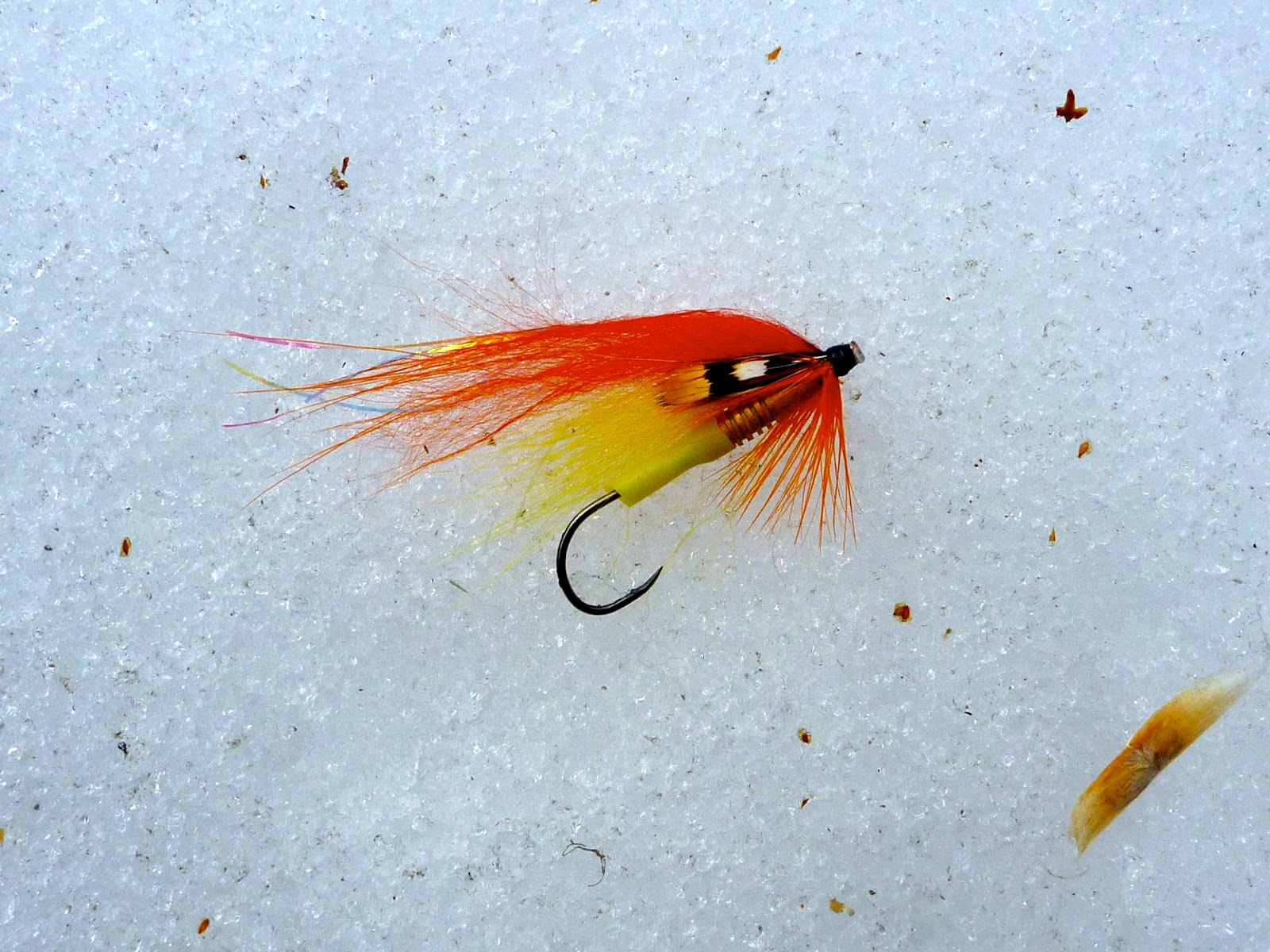
***I made a post about favorite flies for favorite months around the same time as the other 2017 post. The update to that is way more simple...just use Ally's Shrimp in various sizes. It has replaced the Mickey Finn as my ultimate go-to Naugatuck salmon fly. 


One of five hooked on a fruitful day of guiding/fishing last October
(on an Ally's Shrimp) 


Monday, January 4, 2021

Ten Tips for CT Salmon Anglers

A nice male, caught in an under-fished location


Since I took 2019 off from guiding, rarely fished, and largely checked out of what was happening in and around the CT salmon fishing scene, I sort of forgot about how others choose to navigate this fishery. I never forgot how I did things. It came back immediately in 2020. If anything, I found myself thinking more clearly than ever. I fished relatively few flies, but picked them with greater thought. I wasted very little time. If I wanted to use a "novelty fly," I did so on my first pass, when an aggressive salmon would be most likely to take it. If that didn't work, I chose something more "sensible" for the next pass. This fall, the salmon were a little crankier than usual and this season hammered home some important lessons. I know some folks are still struggling to hook up, so I will share a few of these lessons here. 

1. Efficiency is KING 

Every cast has to count. Every cast has to be your best. Every cast has to fish as perfectly as possible. That doesn't mean that you must be able to cast a country mile, but the ability to do so doesn't hurt. Practice casting, but not while you're fishing. Fishing requires a different type of focus than does casting practice. One will suffer if they are done simultaneously. Practice casting in the wind. Practice casting with obstructions. Practice all of that so, when you're actually FISHING, you are making the most of your time by casting as well as possible. When every cast counts, you'll be fishing as efficiently as possible and you will make the most of your day. 

2. Never stop moving 

Move all day long. Don't stop. Unless you're working a fish, don't stand in the same spot for more than two casts. Cover as much water as possible. If a pool doesn't produce, get out of there. Unless you find takers, fish as many pools as possible in the course of an outing. Don't forget to try the water on the margins. You just might find your new honey hole. 

3. The fly doesn't matter 

The fly doesn't really matter. I like to tie, so I have a lot of flies. But I could get by with far fewer. I just need a couple flies for surface fishing, a couple for just under the surface, a couple long and/or heavy tubes, a couple flies for high/dirty water, a fly for low/clear water and a change-of-pace fly or two. Even within that list, I can think of patterns that would do double duty. 

4. Choose your fly with care 

I know I just said the fly doesn't matter. However, some flies are better suited to this purpose than others, and those are the flies I want to have. For example, when the water gets cold, salmon don't take as hard, don't always turn on the fly, and don't often get hooked in the corner of the jaw. For that reason, I use tube flies with a hook that rides behind the materials. People ask if our salmon eat woolly buggers. Of course they do...but I wouldn't be caught dead using a long tailed fly in 36º water. When the salmon takes soft, I want to make sure he gets 100% of the hook in his mouth since I know hooksets are inherently dicey at this time of year. I have specific flies for specific sets of conditions. When they fish are acting recklessly, anything will work. For the majority of the time, I am looking for a fly that will make the most of the conditions at hand, be it water height, temperature, clarity, the amount of sun of the water, etc. 

5. Choose your fly line with care 

Like my fly, I choose my line according to conditions. Unless the water is low enough for me to fish a single handed rod and a floating line, I use a short two handed rod and Scandinavian shooting heads. The bulk of my salmon are caught with a floating head, but I have different densities of head at the ready. Need to fish a fly slowly through heavy chop? A fast sinking tip will get your fly down, but the floating head will still be fishing at the same speed as the surface of the water. Fully sinking heads are the best option for slowing the fly down in a situation like this. 

6. Look for aggressive fish 

This is relative of tip #2. Unless you find a bunch of eager salmon, keep looking for that one aggressive fish. Look for him up and down the river if you have to. Then, once you find and either land or lose him, look for the next aggressive fish. It's ok to spend a little more time on historically productive lies, but don't put all of your eggs into one basket. Keep moving until you find that fish.

7. Don't waste your time in less productive water 

Sure, you might see a salmon jump across the river, in the frog water. Just leave it alone. The cruising fish are hard to pin down and hard to hook reliably. Fish the runs and let the spin fishermen take the frog water. Sure, you might not be casting over every single fish in a pool but, chances are, you'll be fishing over those you're more likely to hook and land on a fly. Plus, you can work through moving water much faster than still water, which brings us back to the ever-important tip #2. If you know some reliable frog water spots, that's a different story. 

8. Wait until you feel the weight of the salmon to set the hook

This is an oft repeated piece of advice. When fishing subsurface, don't trout set or you'll risk pull the fly from its mouth. Slow down. Set the hook when you feel the fish on. Let the salmon do most of the work for you, then smoothly raise the rod. If you use tube flies, there is no need to drive a thick salmon iron into their jaws with a Jimmy Houstonesque hook set. The exception is when stripping flies....(strip) strike first, (strip) strike hard, no mercy, sir! I often strip with two hands so I can remain in contact with the fly at all times. The worst is when the fish takes at the end of the strip and you run out of line to tighten. 

9. The fish moves when it's fighting. Why don't you? 

This one should need no further explantation, yet it does...over and over again. The fish is constantly trying to get a better position on you. Why the hell would you stand in one place and let it? After the fish is hooked, as long as it can't be stripped right to hand, reposition yourself to make the fish work for every inch of line it takes. Boxing isn't just punching. It's mostly footwork. Don't stand still and let the fish pummel you. Keep moving and take back the upper hand. 

10. Put the wood to 'em! 

This is an offshoot of the previous tip. When it comes to fighting larger and/or tougher fish, they will battle to a stalemate if they can. Meanwhile, the hook is getting looser and looser until either you get lucky or the fish does. Put some pressure on that fish. Keep him off balance. Keep pulling the hook into his mouth, not away from his mouth. That's a big one, so I will repeat it. If you're pulling directly upstream on a fish that is directly downstream from you, you will be pulling the fly towards you and away from the fish. By pulling the fly into his mouth, you will be exerting maximum pressure. Then, when he runs, you ease off the pressure. As soon as he stops, put the pressure back on immediately. At some point, either you will end the fight or the fish will. And, if you mess around for too long, you might get lucky, but kill the fish. So play them smart and play them hard. 

*BONUS TIPS*

-Never be afraid to experiment. Sometimes it works and becomes a part of your repertoire. 

-STAY POSITIVE!! I can't overemphasize this! 

-Read books. Read this blog, too. Read anything and everything, regardless of media type. Listen to podcasts. Be an information sponge. Facebook, Instagram and YouTube are great, but solid fishing strategy existed long before color photography, videos, etc. Books...they aren't just for geezers and nerds. It takes actual work to write a book. Yes, you will find some that are a bit suspect, but if someone cares enough about salmon fishing to write a book about it, you can probably learn something from it. No one does it for the money. 

Feel free to comment below...compliments or criticism, either is fine with me. Add some tips of your own, if you're so inclined. I still have a lot to learn. 


Monday, September 11, 2017

Connecticut Broodstock Atlantic Salmon Season: One Hand or Two?


Top: Sage z-Axis 11' 6wt switch rod
Bottom: Orvis Hydros 9'6" 6wt

     When I am guiding, particulairly in the early season, I'm often asked whether a single or double handed rod is appropriate. Before this four year stretch of low water, the answer was easy. Either are fine. It seems like 2017-2018 might be more like a typical year in terms of water levels. Despite having great success in low water,  I'm anxious about getting back to the way it used to be. I miss using the two handed rod in the early season, even if the fish are spread out over a much greater area. 

    During the past several years, I have focused on the lower Naugatuck River, which can be an excellent place to fish either a one to two handed rod throughout the season. I don't recommend a two handed rod for fishing the upper Naugatuck. The river is too narrow. However, single handed spey can come in handy up there. Like the lower Naugatuck, the Shetucket River can go either way. In general, it's wider than the lower Naugatuck, but with a more gentle current. The tips below mainly reflect my experience on the lower Naugatuck, but can be tweaked and applied to the other two salmon fishing areas in Connecticut. 


When to use a Single Handed Fly Rod

     The single handed fly rod is my tool of choice in the early season when the river is at a low-to-normal level. The lower Naugatuck doesn't have bank to bank current, so I think of fishing the runs as fishing a "river within a river." This can be more like small stream angling in that the run might only be 10-25 feet across. Long casts are usually not necessary. The only place where casting gets difficult is where the narrow band current follows the near bank. In this case, single handed spey casts or cack handed casting may be necessary due to the tree-lined banks.

     I like to target the inside and outside seams. Because the water flow is so weak in low water, the fly often has to be animated instead of simply swung through the run. A lot of strikes come when stripping the fly back along the inside seam. Because of this, dealing with running line and a shooting head can be a pain in the neck (more on that later). I have hooked salmon with my mono leader almost inside the tip of the guides. If nothing takes, just shake out some fly line and recast.

    Stripping a fly through slow water can be very effective. I prefer a smooth retrieve, be it fast or slow. I don't let the fly pause. Often times, I place my rod under my right arm and strip with two hands, even when fishing a fly slowly. I can feel as soon as the fish strikes. As opposed to waiting a moment to set the hook, like with a swung fly, I tend to tighten up right away when stripping with both hands. I find a more proactive approach gets a stronger hookset in very slow water. In any case, I find this type of fishing easier with a single handed fly rod.

     If I expect to fish dry flies, I will usually bring a single handed rod, though I fish them on the two hander now and then. I think I am more accurate with a single handed rod. When fishing dries, I mainly fish to known lies or spotted fish, so I want the fly to land exactly where I want it to land.

     My single handed rods of choice are an Orvis Hydros 9'6" 6wt and a Sage One 9' 7wt. If I had to pick one, it would be the latter. The heaviest I go is 8 wt., but it is rare I use it since I don't often fish large, heavy flies with a single handed fly rod.


A two handed set up for high, colored water...intermediate Scandi head,
7.0 ips Versileader, and a big tube fly


When to use a Two Handed Fly Rod

     When the water is right for swinging a fly, I'd much rather use a two handed rod than a single hander. A lot of anglers think it's for distance casting. It does cast further more easily, that's for sure, but it's not my main reason for using a two hander. The banks are lined with trees and can be steep. Backcast room can be limited to virtually non-existent. In this scenario, the two handed rod is definitely superior.

     In higher water, the current still isn't bank to bank. Again, I like to fish the inside and outside seams, but I have to reach further to do it. I also have to control a longer length of line. A longer rod makes it easier to do both. In very high water, there will be some fish lying close to the bank. Either a single or double hand rod will work, but I prefer the versatility of the double.

     Except in really high water, our rivers aren't really good places for traditional spey lines. We just don't need that much distance. Most of my fish are caught with modest length casts, not Hail Marys. As such, shooting heads are good choices. Either a Skagit or Scandi head will work, though I prefer the Scandi setup.

     Most of the time, I'm not throwing a heavy fly. The Scandi system delivers a fly with more delicacy. Also, the airborne anchor creates less disturbance on the surface of the water. One common mistake I see, most often with Skagit casters, is laying the line right over the run and ripping the anchor through water that might hold fish. With an airborne anchor (such as with the single spey or snake roll), the anchor will happen behind or alongside the angler, where fish aren't as likely to hold.

     As the season rolls on, it might be necessary to fish a fly deeper and slower. I used to use floating heads and polyleaders. Now, I find multiple density heads more effective, especially when it comes to slowing a fly down. Both Scientific Anglers and Rio make multi density heads. Guideline makes great heads, too, but they are hard to find in the US. A good selection of shooting heads would include a full floater, float/hover/intermediate (F/H/I), hover, intermediate, S3 (H/I/S3), and intermediate/S3/S5 (I/S3/S5). I don't use the I/S3/S4 much, as these rivers don't have heavy enough current to justify its use. I have it in case I need it, though. Of course, single handed sinking lines can be used on single handed rods, but I find it easier to extract the line from the water with a two handed rod than with a short single hander.

     I don't fish too long of a rod here in Connecticut. I don't often need extreme distance. My early season two hander of choice is a Sage Z-Axis 11' 6wt. I like to use a 325-350 grain Scandi head with this rod (floating). When I need a little more power, I use a different rod. This year, I'll be using a Sage TCX 11'9" 6wt. It prefers lines in the 374-425 grain range. This is the rod I use with sinking heads and when I need to cast a larger fly or throw a bit longer line. If I really need to cast far, I use a 12'6"-13' rod, but nothing longer than that.


------------------------------------

High water salmon....lower Naugy @ 1000cfs
Time for a longer rod, this time a 13 footer

     Regardless of water levels, I always travel with both single and double handed rods. When the river is at that sort of "in between"level, I might use either, or even both, depending on the pool. Be prepared. It's better to have it and not use it, then to need it and not have it. A lot of anglers so desperately want to use the two handed rod that they neglect the effectiveness of the single hander in certain conditions. For me, the job is fun, regardless of the tools needed. 


Monday, August 28, 2017

Connecticut Broodstock Atlantic Salmon Season: Month by Month

A handsome early season salmon

     As I'm starting to compile a list of anglers interested in guided trips this season, I find myself typing the same information over and over again. Most of it has to do with the when to plan a trip, as the character of each month can very different from the other months. This information might be helpful to the greater public, plus I won't have to type it out again if I post it on my blog. Here is the rundown as I see it and as it pertains to the Naugatuck River fishery:

September: As far as I know, there has only been one season with a September start, which was in 2013. This was before the state published stocking information on social media sites and I had some "inside information" about when the surprise first stocking would happen. I was out on the river as soon as I could get there and I had the place to myself for about two weeks. I caught a bunch of salmon, however, the temperatures were borderline for a safe release. At that time, a salmon could be harvested in September. The only one I ever kept was one, caught that September, that I couldn't revive. Now, September salmon can no longer be retained. 

     Because of the borderline water temperature (often reaching 70º by mid day), fishing was best early and late. The fish were very active and aggressive when the temperature agreed with them. When it got too warm, they sulked. As such, I planned my trips for times it would least dangerous for the salmon, opting to stay home on the warmest days. Once we got into October, the temperature was no longer an issue. 

     I don't know if we'll ever see a September start again, but it was nice. As long as anglers pay attention to the water temperatures, it can be a fun and productive time to fish, particularly with small flies, dry flies, floating lines, and single handed rods.


I suspect this extremely hard fighting salmon was one of the barren fish. 

October: Traditionally, the first salmon are stocked during the first or second week of October. The first salmon are small, averaging 3-6 lbs. What they lack in size they make up for in spunk. These fish are usually aggressive, take a fly well, and are willing to rise to a dry fly under the right conditions. The chance of catching a barren salmon exists now (one that won't spawn). Barren salmon fight much harder than post-spawn hatchery fish. The best broodstock salmon fights I've experienced have been with what I suspect were barren salmon, which are usually more silvery than dull gray. They are still feeding and are suckers for a sz. 6 Mickey Finn. 

     The fewest number of salmon are in the river in the first half of October, but it is my favorite time to fish. We haven't turned back the clocks yet and the evening bite is usually still good. The fish will take a variety of flies, will be interested in different presentations,  and will chase long distances. When hooked, many will fight hard and will jump several times. If you're lucky enough to hook into a barren fish, you might even see some high flying cartwheels.  

     Late October is a transitional period. I usually start out with a single handed rod. If we have a low water autumn, I will stick with that rod for the month. If we experience normal-to-high water, I fish a short two handed rod, usually no longer than 12' or so. The water is still warm enough to get salmon to the surface, so I rarely use a sinking tip or line. 


The larger fish now make their appearance later in the season. 

November: The first Sunday in November brings us one less hour of daylight. November also brings us falling temperatures and lots of falling leaves. Though the leaves can be a nuisance, the salmon will still take flies. We might even get accumulating snow in November. The water is usually high enough to use a two handed rod all month. Early in the month, an unweighted fly on a mono leader is usually enough. As the month goes on, however, it might be necessary to use a polyleader, sink tip, and/or weighted fly to get down to the more lethargic fish.

     The larger salmon make their appearance starting in November, typically near the middle to the end of the month. The salmon can weight up to 20 lbs. or more. In past years, large fish weren't all that uncommon. Now, there are much fewer than there used to be, though they can still be targeted. With a little luck, they can be hooked. With even more luck, they can be landed! 

     Due to the falling water temperature, the fishing in November is usually a little slower paced than in September or October. The trade-off is that there are more fish in the river and there is the chance of catching a much larger fish. A warm spell in November can mean terrific fishing. The dry fly isn't as much of an option, however, the first dry fly CT salmon I caught was during a November warm streak. Anything can happen. 

     I guide more during November than any other month. It's probably the best month to get an overall feel for the fishery. The fish have spread out by then and more pools are in play than earlier in the season. It sounds strange but, on the lower Naugatuck, the higher water actually makes wading easier, allowing the angler to fish further down the runs in the less rocky sections. 


December brings sinking lines and bigger flies

December: Without a doubt, December is the oddest of all the months. Usually by early December, all of the that season's salmon will have been stocked...but...anglers are allowed to retain one salmon per day beginning on December 1. For a brief period of time, there will be more (and bigger) salmon in the river in December than in any other month, although, this is a declining balance as fish are caught and kept. Also, the old salmon will have really spread throughout the system by December.

     I have had tremendous fishing in early December some seasons. I've also had some pretty forgettable fishing in other years. The quality of the fishing is usually dictated by the weather. December 2015 was really warm and the fishing was off the charts. It was one of my best months ever. I've had a few 5+ salmon days in various Decembers. But it is a crapshoot. 

    Knowing the movement patterns of the salmon helps figure out where salmon will be lurking in December. They are usually getting ready to hunker down for winter. Covering water is essential as the fish tend to spread out more and hold in slower water. As such, a two handed rod is a very useful tool since sinking lines become a regular piece of gear. The small flies of the early season get put back into their boxes, away go the dry flies, and large, mobile tube flies become most useful. 

     As is the case in November, a warm stretch can really make for good fishing. Most of the days will be cold, however, and the best fishing confined to a short window in the early afternoon. By 4:45pm, it is often too dark fish and the fish are too lethargic to bother leaving their lies. Our commute home is just in time for rush hour traffic. 

     When it comes to my own fishing in December, I tend to cherrypick my days and times. I don't spend all day on the river. This is a time of year when I actually recommend half day guide trips over full day trips. Like I said before, it's a gamble, especially when planning far in advance. 


A nice salmon, caught on Dec. 27, 2015. This was one of five that day. 

Winter (January-March): Admittedly, I don't fish often during the winter months. I'm usually sort of tired of it by then and I have a lot of tying to do for customers traveling to Canada and Europe for Atlantic salmon fishing in the spring and summer. When the weather warms up for a few days, I'll go out and try my luck as long as the river isn't too icy. A warm streak will melt snow and bring up the river, but the fish will usually go on the feed. If there hasn't been too much retention, it can be possible to catch a fish or two, sometimes more. Mid-to-late March can be good if the winter isn't too brutal or lengthy. I had a particularly good March a few years ago. There are no guarantees when it comes to salmon fishing, particularly at this time of year. 

     Expect to fish low and slow during the winter. Cover water and fish the middle of the day. It's not necessary to get on the river in the early morning and it's usually not necessary to stay until sunset. It's a good way to fight off cabin fever. If there hasn't been rampant poaching and/or retention, there will still be a fair amount of salmon around, certainly enough to target. 


Small, silvery salmon caught on April 29

Spring & Summer: The salmon season closes temporarily beginning on April 1. It reopens on opening day, which is the second Saturday in April. If there are enough salmon left to target in spring, they will be on the feed. The sinking lines can be ditched in favor of floating lines and mono leaders as long as the river isn't too high. The salmon pictured above was caught on April 29, which is the latest in the spring I've ever caught one (I've usually moved on to spring runs by then). It can be worth a shot if you know where salmon might be. The bonus is that there are usually trout around at the same time.

     The latest I've heard of a salmon being hooked was during a cold period in early July. It appears as if some actually hold over, though it is anyone's guess if they can make it through the heat of August and early September. I once tried to find them in July, based on some local intel. I waited until we had some unseasonably cool weather and was fishing at first light. The water was about 65ºF. I didn't wind up finding any salmon, though I landed a beautiful, acrobatic, holdover rainbow trout. 

----------------------------------------

     That's the long and short of it, at least in my experience. Though I fish the Naugatuck River, I imagine the Shetucket follows similar patterns. I like my broodstock salmon fishing to mirror my wild salmon fishing as much as possible, so I tend to favor the warmer months, or at least the months that aren't too freezing. I have a couple friends who prefer the cold and who do quite well in winter. To each, his or her own. 

If you have any questions, you know where to find me...