Friday, December 13, 2013

Naugatuck River - Fall 2013: Observations & Thoughts

A two-handed rod can be a valuable asset in hard-to-wade pools

On Tackle...

Before this season started, I was unsure whether or not to use lighter gear due to the smaller size of the salmon. Especially in September and early October, I caught fish on a wider variety of rods than I've ever used in the past. On the lighter end, I landed salmon on an Echo 10'6" 4wt. switch rod. As long as the fish was far from me, the rod handled wonderfully. It definitely lacked backbone when I got the fish in close, however. I also used a Vision GT Four 9' 6wt. single handed rod. That was fine for some fish, but one salmon really kicked my butt on that setup. Though these fish can feel lethargic (especially come November), if you hook into enough of them, you will find some real tough guys mixed in. This is especially true when the water is warm. When the water temps are in the mid to upper 60s, you want to play these fish hard and fast. Sure, pretty much all of them can be handled on lighter tackle, but why stress them unnecessarily? After landing a few, I went back to using the same gear as always. As I've stated before, my main three rods are:

9' 7wt. Sage Graphite II - a nice medium-fast action IM6 rod
11' 6wt. Sage Z-Axis switch rod - my bread and butter rod
11'3" 7wt. Redington CPX switch rod - for heavier flies and fish

The water was very low most of the fall. Most of my takes were induced rather than on the pure swing (flies were stripped, drawn in slowly, hand twisted, etc.). As such, I found it much easier to use a single handed rod in most situations. The 9' 7wt. Sage was just right for what I needed to do. 

I think using a long leader really helped a great deal. An 8' or 9' leader is usually all that is required, but I used a 12' tapered (hand tied) leader for much of the early season. Maxima Chameleon was fine,  I didn't need to resort to using fluorocarbon. I fished a lot of size 10 flies this year and coupled them with 6 lb. test, which I felt was stealthy enough and still quite strong. As the season progressed, I shortened my leader, sometimes fishing a straight, 9' piece of 12 or 15 lb. test Maxima.

In the tackle department, the single best decision I made this year was to start carrying a net. When 8 lbs. was the average size of a CT salmon, tailing a fish was my preferred way of landing them. It can be difficult to tail a smaller salmon. Even if I felt comfortable with the "Vulcan Grilse Grip," I'm confident I can land a small fish faster with the net than with my hands. I settled on a Brodin Trout Bum net (San Juan model). The aluminum frame is nothing fancy, but it's very durable and will never warp. Though it's large for our average river trout, the net is just the right size for smaller salmon.


An Owner hook in the mouth, a Same Thing Murray tube fly safely
up the leader and a salmon in the net...everything's working just right


On the salmon themselves...

I have to say, I had some memorable scraps this season. Given the smaller size of the fish, I thought I might get bored relatively quickly, but that wasn't the case at all. Overall, they were a very acrobatic bunch. Not only that, but some were quite strong for their size. I chased more than a few around this season. I think a lot of the very early fish hadn't spawned and were still full of piss and vinegar. It wasn't unusual to hook into a bright silver salmon early in the season. 

I'd say my average fish was 4-5 lbs. I caught a couple really tiny salmon and a few larger ones, though I didn't land any of the big boys this season. I lost one that I'd estimate was 12 lbs., but nothing like the fish in the upper teens I've caught the past few years. I'm not complaining, though. I'd rather catch really spirited smaller fish than lethargic larger ones. 

I caught more well-conditioned fish than ever this season. Maybe it's because they're a year younger than they used to be and there's less time for them to get battered...I'm not sure. The toughest fish I landed were almost always in pristine condition. Sure, I caught some beat up ones too, but I caught a much higher percentage of good looking fish than I ever have. The crew at the Kensington hatchery deserves a big "thank you" for all the hard work they do to provide us with this unique fishery! 


No surprise, the Polar Bear Mickey Finn was my best fly this season

On flies...

In seasons past, I'd usually catch a fish or two on a size 10 wet fly. This season, I hooked 10 salmon on 10s. Though I could have lived without the dead low water, I really enjoyed fishing small flies and long leaders this season. I suppose that went hand in hand with the conditions, though. 

Not surprisingly, the Mickey Finn came out on top this year. Strangely enough, all eight salmon I hooked on it took a size 6. When I fished it in other sizes, the salmon wanted nothing to do with it. Historically speaking, that has always been the most productive size for me. I don't know what it is about this fly they love so much.

I've come to the conclusion that, as long as the water isn't too colored, I only need one fly for dark days on the Naugatuck River. At least for me, the Same Thing Murray has been peerless under these conditions. It finished a very close second behind the Mickey Finn. However, if I had factored guide trips into my stats, the Same Thing Murray would have bested the Mickey Finn. It doesn't matter, I can't be without either one. Unlike the Mickey Finn, I had success with the Murray in wide range of sizes, from #2 all the way down to a small #10 (tied on a trout hook). 

Third place was the Snaelda, which beat out last season's top fly, H.M.'s Sunray Variant, as the top tube fly of the year. The German Snaelda (pictured below) was the most effective color scheme. I had success with two varieties of German Snaelda. One was relatively small (1/2" copper tube, 2" overall length) and was tied with bucktail. The other was larger (3/4" copper tube, 3" overall length) and was tied with arctic fox. If I had to choose one or the other, I prefer the smaller Snaelda tied with bucktail. The other Snaelda which worked well for me was all-black and tied, with bucktail, on a 1/2" copper tube. That fly worked particularly well on warm, sunny days when the fish were hunkered down in the fast water.

As I mentioned in prior reports, this is the first season in which I've had success with Buck Bugs. Until recently, I fished various bugs for years without even a sniff from a Connecticut salmon. Perhaps due to the low water, the salmon were more surface oriented than usual this year (more on that below). That's the only explanation I have for why Buck Bugs seemed to produce for me this year all of a sudden. A more likely explanation is that I fished the bugs in pools I knew were full of grabby fish. Perhaps it wouldn't have mattered which flies I used? Either way, I'm relieved that the "Broodstock Buck Bug Boycott" is now over! 
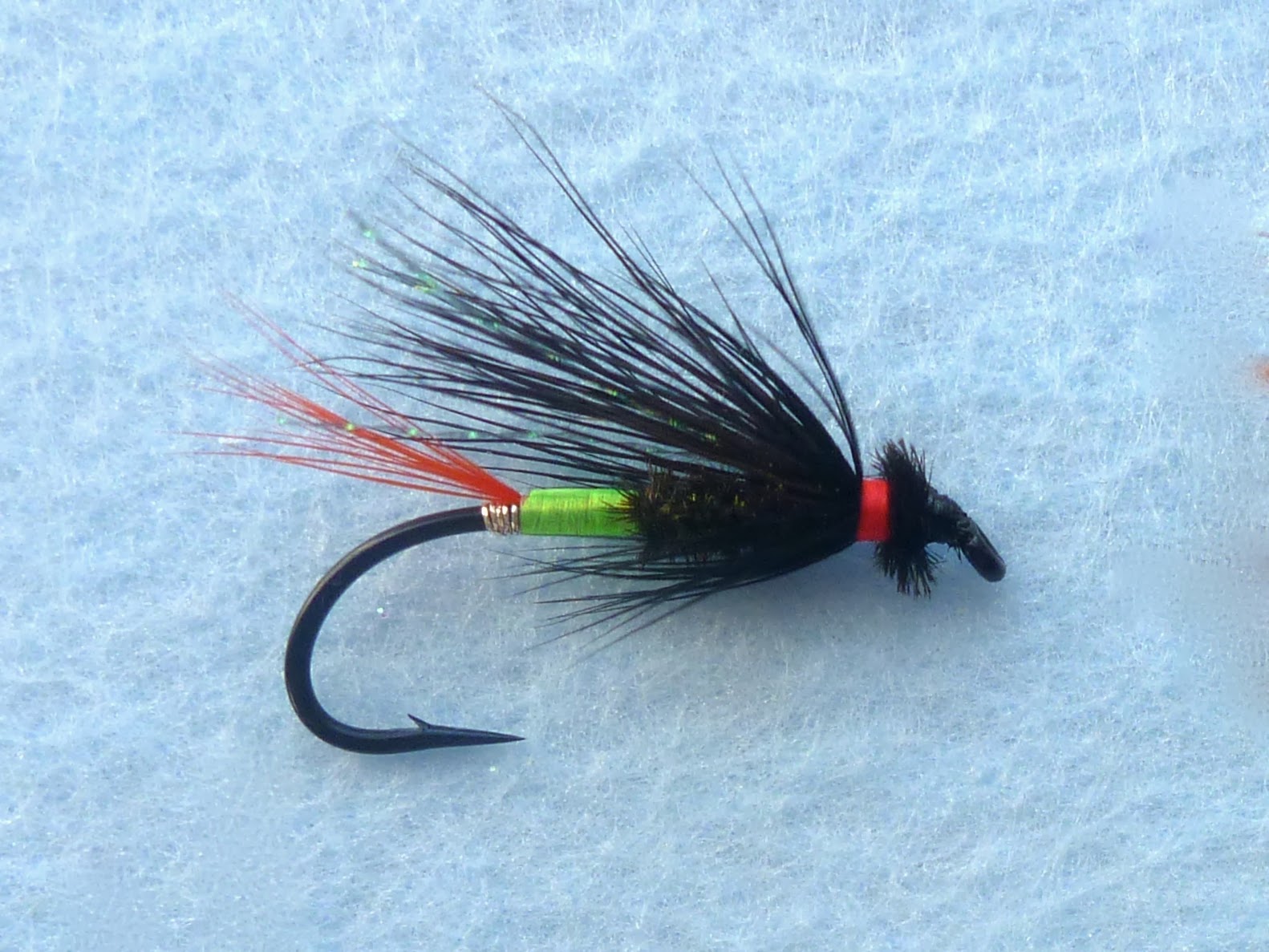

On overcast Naugatuck days, the Same Thing Murray is
my hands down favorite. Nothing else even comes close.

On fishing methods and techniques...

As I look back through my notes, the thing that stands out to me the most is that, out of the thirty-six salmon I hooked this year, not one of them was hooked while using a sinking line or sink tip. Not even one! I devoted time to fishing a sunk line once the water cooled off, but I can only recall moving one fish with that setup (it never came back for the fly). Even my last outing, with a 42ºF water temperature and a river falling from a good rain storm, salmon were still willing to rise for a fly! 

That's not to say my only action was on unweighted flies. It most certainly was not. I hooked seven salmon on copper tube flies, but they weren't fished on anything more than an intermediate polyleader. In fact, some of them were fished on a 100% mono leader (to get down quickly through the choppy water at the heads of pools). 

This got me thinking about something I read regarding catching Pacific northwest winter steelhead on or just under the surface. If I remember correctly, the author stated that, even in cold water, it could be done so long as the air temperature was warmer than the water temperature and the water temperature was actively rising. Near the end of November, a friend of mine caught a Naugatuck salmon on a dry fly in water I previously would have never thought capable of being productive with dries. I had taken my dries out of my pack a couple weeks prior to this trip. I saw him catch the fish and the wheels in my head started to spin. I switched back to a mono leader and caught a fish just under the surface very shortly thereafter. Maybe there is really something to the wintertime rising water temperature theory?

This leads me to my biggest regret of the season. Prior to the season opener, I resolved to fish the riffling hitch as much as possible this season. I even tied a bunch of hitch tubes of various sizes and color variations. For some reason, I just didn't give them much of a shot. I had one fish grab a waking dry fly. My hottest fish of the season boiled for that same waking dry fly. If nothing else, a skated dry proved to be a great "fish locator" for two very aggressive salmon (who were both later caught on wet flies). Would either have chased a hitched tube? I think they might have, and possibly others, too. It's going to have to wait until next season, but barring extreme high water conditions, I'm going to actually fish the hitch more.

Last season was the first time I fished Sunray type flies with a two handed strip. I stripped those tubes as fast as I possibly could and fish nailed them like crazy. If they didn't nail the tube, it at least gave up their locations and signaled that they were willing players. That didn't work too well this season. I did catch four salmon the H.M. Sunray Variant, but three of them were caught on the same day. I think that approach was too aggressive for them in the extreme low water conditions we had this year. Previously, the Sunray was my last resort. This season, I found the copper tube (mainly the Snaelda) and a slower presentation a much more useful last resort tactic, even in warm water.

The German Snaelda is tough to beat

The low water can be a pain in the neck. I enjoyed it at first, but it really overstayed its welcome. There's one particular pool I'm really not too fond of. It's very heavily fished, difficult to wade, hard to land fish alone, very slow in low water, has some very troublesome obstacles, etc. This spot really drives me nuts, but I do quite well there, so I continue to fish it. When the water is really low, the salmon seem to lie in a deep trough on the near side of the current. Swinging flies is almost impossible. The water moves too slowly. I tried dead drifting a dry fly, but it wasn't too effective.

The best technique I've found (at this pool) in low water is to use a long leader, small wet fly and a slow, steady draw. I cast the fly to the edge of the current and I retrieve one of two ways:

1. I put my line hand all the way up to the first guide and pull the line down, past my hip, very slowly while still keeping the line tight. Eventually, I can't strip any farther and have to start over again.

2. I cast and immediately place the rod under my arm. I strip with two hands, but extremely slowly. It's really similar to the approach above, but the fly never stops moving.

Both techniques proved themselves deadly in this particular pool. I'm not exaggerating when I say it was almost a spectacle on a couple of occasions. I'd show up to the pool and find either spin fishermen throwing medium sized lures or fly anglers throwing weighted buggers or larger streamer type flies. Keep in mind, it was still quite warm out. I'd rig up my 9' 7wt. with a 12' mono leader, tapered down to 6 lb. Maxima. My flies of choice were either an M1 Killer, Sugerman Shrimp or an Almost, all size 10 (sometimes even tied low water style). I think the salmon were put down by all those big lures zooming in front of their faces. I gave them something different...a small, often subtly dressed wet fly, fished high in the water column and just barely faster than the current. This lie is quite deep, but the salmon would come right up to the surface for these small flies. This method produced some vicious takes!

Little killers (top to bottom): M1 Killer, Red Butt Butterfly & Almost

Overall, I'm very pleased with how this season went. I had really good time, especially in September and early October. The weather was warm, the fish were often very aggressive and many fought quite hard, despite their reputation. I've said it a million times...get out there early in the season. I think a lot of people wait until most of the fish are in the river. You won't catch me doing that! Even if there are relatively few fish around, the ones that are there will still set up in the best lies. At that time of year, those lies are usually great taking lies. Maybe I'm cursing myself here, but I fished alone an awful lot in the beginning of the season. I'm not complaining. I prefer it that way! It just seems like most people go out a couple of times in November, maybe they hook something maybe they don't, but they miss the most exciting time of the year. Our season started in September this year, well earlier than I can ever recall it starting before. It was great! I hope that continues. Don't take my word for it though. Get out there early and see for yourself. Or don't...I'm more than willing to shoulder that burden!

I'm going to keep updating this blog throughout the winter, so keep checking back. I have a very special joint project in the works with Paul Beel at FrankenFly. I have to wrap it up, but the hardest part is already done. Look for it sometime in early 2014. Also, I wanted to have a giveaway for my 100th post...sort of a "thank you" for your support. #100 happened a couple weeks ago, but I still want to make it happen, albeit belated. I have some good gigs coming up, so there might be a brief lull here for a few weeks.  I'll be back at the vise soon though. As always, feel free to contact me if you have any questions.

Have a happy holiday season!

Tuesday, December 10, 2013

Naugatuck River - Fall 2013: Data

The leaves are all gone and winter is almost here

I never have been one to keep a fishing journal for my trout fishing. I guess I'm just not into entomology and typical trout stuff all that much. As far as sea run trout go, I can see myself starting one eventually, mainly to document run timing. I used to keep a broodstock salmon journal to document effective techniques at certain temperatures, water levels, etc. I got lazy last season and didn't write anything down, which I now regret. This season, I decide to make this blog my journal. It helps me keep track of trends and maybe it will help some of you, as well.

Though it's still technically autumn, I wrapped up my fall CT salmon fishing season with one trip in December. I have tallied up all my stats, effective flies (and sizes), trips per month and as much other relevant information as I can think of. Please forgive me if the data portion of this summary is sort of dry sounding but, like I said, this blog has become my journal. In addition to the data, I will post some general observations I have made in a follow-up post. Hopefully, that will be more interesting. 

Note: When collecting data on effective flies this fall, I am only including instances of salmon being legitimately hooked. With the exception of dry flies, I am not including information of flies which might have rolled a fish, gotten a pull, pricked a fish, etc...only flies which actually hooked a salmon long enough to be on the line for at least 10-15 seconds or so. Also note, this data only pertains to my own fishing, not from trips in which I was the guide. 

Number of Trips & Success Rate

Total number of trips to the Naugatuck River: 15
Full Day Trips: 9
Partial Day Trips (3 hours or less): 6

September Trips: 5
October Trips: 6
November Trips: 3
December Trips: 1

Salmon hooked: 36
Salmon landed: 29
Average hooked per trip: 2.4
Average landed per trip: 1.9
Largest salmon landed: about 8 lbs. (3 salmon this size)
Smallest salmon landed: 2 lbs. (2 salmon this size...a liberal estimate on both!)
Largest salmon hooked: estimated 12 lbs. (lost after several minutes)
Incidental trout catches: 1 (small brown trout, possibly wild)

Skunkings (trips w/no fish landed): 4
Trips w/o a hookup: 2
Trips with absolutely no action of any kind at all: 1 (cold day w/falling temps & colored water)
Trips with more than one salmon hooked: 8
Trips with six or more salmon hooked: 3
Best single day: 7 hooked, 7 landed (October 10th)
Pairs of forceps lost: 2 (1 expensive, 1 cheap)

Environmental Data

Highest recorded water temp: 68ºF (September)
Lowest recorded water temp: 40ºF (November)

Highest flow fished: about 350cfs (November)
Lowest flow fished: about 120cfs (October)

*Vast majority of days fished were when flows were below 200cfs (yikes)

Top 3 flies for 2013 (clockwise from upper right and in order):
Mickey Finn, Same Thing Murray & Snaelda (German and all-black)

Effective Flies (# of salmon hooked)

Conventional Flies:

Mickey Finn: 8 (all on a sz. 6)
Same Thing Murray: 6
M1 Killer: 3
Buck Bugs (various colors): 3
Sugerman Shrimp: 2
Almost: 1
Black Bear/Red Butt: 1

Tube Flies:

Snaelda (various colors and sizes): 5
H.M. Sunray Variant: 4 (3 w/orange & black; 1 w/white & black)
Ally's Shrimp Tube: 1
Same Thing Murray Tube: 1
Willie Gunn (w/gold body): 1


Effective Fly Sizes

#10: 7 salmon hooked
#8: 4 salmon hooked
#6: 10 salmon hooked
#4: 1 salmon hooked
#2: 2 salmon hooked

Aluminum tube flies (various sizes): 5 salmon hooked
Copper tube flies (various sizes): 7 salmon hooked
Plastic tube flies: 0 salmon hooked

Other Fly Data of Interest

*Dry flies were responsible for raising three salmon, two of which were later hooked on wet flies.

-both fish raised on a #6 Titanic were hooked and landed

-one fish was raised with a #6 Green/Brown Bomber, but was not hooked at all

* A hitched Sunray Shadow variation (yellow tube w/orange and black wing) raised one fish, but I'm not sure if it was a trout or a small salmon, as the fish was never hooked

------------------------------------------------------------

In my next post, I'll summarize my fall season with some general observations. I promise that post will be more interesting than this one is!

Friday, December 6, 2013

Naugatuck Report - December 6, 2013 - Who Needs Pink Flies?

A useless Pink Cosseboom
Hopefully, I will be proven wrong next season

When it comes to flies for broodstock Atlantic salmon, all I hear is "pink, pink, pink..." I have heard about the deadliness of pink flies for years. I tied a bunch of pink flies for today to see if all the praise is actually warranted. Some of the flies were predominantly dark with pink accents and some were bright, garish looking things. I wasn't going to fish the pink flies to the exclusion of everything else, but I figured I'd give them a fair shot in the rotation.

Other than the pink thing, I had a pretty modest goal today. I only needed to get one more salmon on the line to have hooked thirty for the fall 2013 season. One salmon hooked really isn't aiming too high, though anything can happen, be it good or bad.

I was happy to be reacquainted with my recently repaired Sage Z-Axis 11' 6wt. switch rod. I have been without my main Naugatuck salmon rod for over a month while it was at Sage HQ in Washington. We finally have a decent flow, so the two hander is a viable option once again. The water was 42ºF and the weather dreary and rainy, but relatively warm for December. I fished a floating head and a 10' intermediate polyleader with about 6' of Maxima Chameleon tippet, 12 & 15 lb. test. Given the conditions, it seemed like a faster sinking tip might be more appropriate, but I'd rather err on the side of fishing too high than too low, at least at first. Besides, if necessary, switching polyleaders or even heads is easy and takes very little time. 

In all, I fished six different pools today. Here is a brief summary of each:

Pool #1 - In my first pass through the pool, I raised a salmon on a #2 Crosfield's Black Silk (linked is the fly masterfully tied by my friend Marc LeBlanc from Moncton, New Brunswick). I couldn't convince him to come back, however. I tried the Pink Cosseboom (#2) on my second pass, but there was no interest. In my experience, the Same Thing Murray is virtually peerless when used on dark Naugatuck days. I tried a #4 Murray and hooked and landed salmon #30 in short order! My modest goal had been met early, so now I could relax a bit. Nothing else happened at Pool #1, so I moved on. 

30th hooked for the season

Pool #2 - In my opinion, this pool fishes best in low water. The water wasn't exactly high today, but it was high enough to make this a losing proposition. I didn't stay long. 

Pool #3 - This pool is new to me as of this season. It produced well for me when the water was very low and warm. I did nothing there today and moved on quickly. 

Pool #4 - Pool #4 was at the perfect level. The fishing was incredible; 5 lb. landed (#2 Murray), 8 lb. landed (German Snaelda; .5" copper tube), 6 lb. landed (German Snaelda; .5" copper tube), 6 lb. landed (Murray tube fly conversion; 1" copper), 12 lb. hooked and lost (Gold Bodied Willie Gunn; 2" copper tube)...Wow! 

Salmon #5 of the day took a ridiculous looking Same Thing Murray tube conversion on what was supposed to be my last cast in the that pool before leaving and moving upstream. The fish took on the reel-up! It wasn't elegant, but I'll take it. The best part about it was that it persuaded me to give the pool one last run, which was when I hooked and lost the 12 pounder. I lost what would have been my biggest of the season, but I still left very satisfied. 

The Same Thing Murray Tube Fly (1" copper)
I don't know what I was thinking when I tied this, but I'm glad I did

Pool #5 - On my first pass through the pool, I landed an 8 lb. salmon on the #2 Murray. This fish was quite a jumper. He seemed to be the only player in this pool today.

Pool #6 - At this point, I only needed to land one more salmon to have 30 landed on the season, a milestone that wasn't on my radar as of this morning. It was getting dark and Pool #6 was my last chance. Unfortunately, it didn't pan out.

The final tally was seven hooked and six landed. None of them took a pink fly. Other than the oddball Murray tube which, strange as it looks, is still "salmon colored," all seven fish took conventional salmon flies and tubes. Might one have nailed a Black Bear Pink Butt or the Pink Cosseboom? Maybe...I should have tried them while at Pool #4, though I'm reluctant to switch when tried and true salmon flies work as well as anything (and better than most). I guess I'm not convinced that pink is all that everyone around here makes it out to be. That said, I still haven't given it a fair shot. There's always next season, I suppose...

So that's it for me for 2013...I'm done! It was a lot of fun while it lasted. Fall 2013 on the Naugatuck was very productive for me, but it is time to move on. I'll wrap up this season in my next post and we'll see which fly wins the prize this year. Stay tuned!

Friday, November 22, 2013

Naugatuck Report - November 22, 2013 - You Can't Keep a Good Salmon Down (Carter's Bug!)


Nice to see you again, stranger

To say I haven't been fishing much lately would be an understatement. First, a stretch of good gigs kept me off the water. Then some guide trips got me back on the water, but not actually fishing myself. That's okay, my clients caught fish and I was happy. Then the flu took me off the water again, which was pretty miserable.

I had a pretty good streak going earlier this season. I don't know the exact figure, but I think I landed in the neighborhood of 15 salmon in a row without losing one. There were a couple I definitely should have lost in that stretch, but I got really lucky. The universe and the salmon struck back, however. If I look back at my reports, the last salmon I actually landed was a month ago, on October 21. Yikes! More alarming is that I've only fished three times in the space of a month. Losing that hour in the evening now prevents me from making any more end of the day fishing trips. I guess I'm happy I was able to fish as much as I did early in the season.  

So today was the day to end the streak and get back in the black. Of course, despite rain, the water is as low as ever. It's way too low. Not only does it prevent the salmon from moving, but it pushes all the anglers together. The water was warmer than I thought, topping out in the mid 40s. It was damp and cloudy, but the air temperature was relatively warm (50s). 

I thought for sure it was time to start sinking a fly. I thought wrong. They wanted nothing to do with a sunk fly. It amazes me that they're still going after the same stuff I was fishing in mid October. I rolled a few fish on a #6 Same Thing Murray and a #6 Mickey Finn. The only solid grab I had was on the MF, however. The salmon pictured above broke my dry spell, thank goodness. 

Blah blah blah...whatever...Here's the good part...

I met up with my friend Roger for couple hours this afternoon. It didn't take long for Roger to roll a salmon with his Matuka. A few minutes later, I saw Roger playing a fish. I went downstream to lend a hand with landing the salmon. I got the fish in the net, took a closer look and did a little double take when I saw the fly in its mouth. Roger caught that sucker on a dry fly! A proper salmon dry fly... a grizzly and white Carter's Bug! And well into November to boot! Roger mentioned that his friend took another on a Bomber a few days prior. So not only are the salmon still interested in wet flies fished high in the water column, but they're even taking flies on top. Despite cold weather and falling temperatures, it seems like the fish are still taking their cues from the water level more than anything else.

Check out the fly...a white & grizzly Carter's Bug!

Let that be a lesson to me. Just when I thought the salmon had reached the height of their unpredictability, they seemed to go that extra mile. I abandoned dries about a month ago. Sounds like I should have kept fishing them all along! 

Naugy salmon on a dry...welcome to the club, Roger!

I don't have many more fishing days left in me this season. Hopefully this wasn't the last one. Soon it will be time to start tying fancy flies once again.

In the meantime, enjoy this video of Bryant Freeman tying Carter's Bug...


Saturday, November 9, 2013

Naugatuck Report - November 9, 2013 - Fussy, Fussy, Fussy

The Pearl...came soooo close today...ugh

It was a frigid morning and I had a feeling fishing would be tough today.The water, low like always, was around 44ºF when I arrived. It probably warmed a bit during the day, but I doubt it made it out of the 40s. These conditions can be a bit baffling. Low and cold is a tough scenario. I've caught fish on small flies (#10) on a sink tip, well sunk large tubes, conventional flies fished just under the surface, etc. Just about anything might work and there just isn't enough time left in the day to try it all.

I fished two rigs today, a 9' 8wt. with a 9' mono leader an 11'3" 7wt. switch rod with a 460 gr. Rio AFS intermediate head and mono leader. I used a variety of flies, from relatively small, light ones to heavy copper tubes. I fished most of the day with only two bits of action. 

The first came on a classic salmon fly called "The Pearl." I desperately want to hook something on this fly. I tied this G.M Kelson pattern for Mike Radencich's latest book "Classic Salmon Fly Patterns" (p. 182).  I've had success with a couple of classic patterns, but never with one tied on a blind eye hook. I tied a smaller version of the Pearl (#2) for fishing this fall. Today was the first time I had the opportunity to fish it. 

The Pearl - "Classic Salmon Fly Patterns" (Radencich, p.182)

I swung it through a reliable lie. A salmon rolled for the fly, but I couldn't get him back. I decided to rest the spot and try again after fishing through the pool. The next pass went exactly the same as the first. I rested him again and fished through the pool once more. The third pass produced a strong pull from the salmon, but that's where it ended. I thought I was going to finally catch my first salmon on a gut eyed fly, but it wasn't meant to be. 

The only other action came just before dark. I had exhausted all the sensible options, so I figured it was time to go to the Frances. I tied on a Black Frances (1" heavy copper tube) and started casting upstream. I mended to get the fly down and worked my way down the pool. I've never had success with this approach before, but it's probably because I've never given it much of a chance. Well, it did produce a pull from a salmon, but nothing more. 

In retrospect, I should have tried the Frances approach at the other pools. In my opinion, it's not a very pleasant way to fish, but I'm starting to see the value of it as sort of "last resort" when the fish are in a sulky mood (as they were all day today). The H.M. Sunray, fished at light speed, is my typical last resort. It was totally ineffective today. The Francis is probably a good arrow to have in my quiver. 

No one I spoke with had any action, so I guess it was just one of those days. It's not the first and it certainly won't be the last. I think we've finally turned the corner in terms of temperature. From this point on, I will probably fish the vast majority of my flies lower in the water column. From mid-Spetember through the first week of November, I felt the need to sink a fly only on the warmest of days, in the fastest water…and even then only on a couple of occasions. So far this fall, almost 90% of my salmon hooked have been on a mono leader and an unweighted fly. It was a good run while it lasted!


Friday, November 8, 2013

Naugatuck Report - November 7, 2013 - Guide Trip

Fish on!

Weather wise, today was a strange day. I believe the fishing day started in the low 60s. I was too warm and started to remove layers. It was cloudy and drizzly, but the air temperature was very comfortable. The water topped out around 55ºF (the last we'll see of prime temps, I think). As usual, the water was low. That sort of goes without saying at this point.

Warren and I met a little before noon and he was tight to salmon #1 within the first hour. This one didn't mess around, grabbing a #4 Same Thing Murray the first time the fly swung by him. 

We're still not sinking a fly unless we absolutely have to. They're still eager to rise for an unweighted wet fly, though I think that will begin to change as the cold weather rolls in this week. I sound like a broken record, but I have no idea why anyone would fish heavy flies and tips when it's unnecessary. First of all, I don't know any fly fisher who prefers chucking weight. Also, if a fish shows interest in your fly, you want to be able to see it. You don't always see the fish move when you're fishing lower in the water column, especially in broken water. It pays to start high, then work your way down. They're Atlantic salmon...they like to rise for flies, perhaps even more than trout do.  Refer to salmon #2 below for an example of why it pays to start with your fly on or just beneath the surface...

Salmon #1 of the day

On our way to pool #2, we felt noticeably cooler. I stopped by the car to add a layer. About midway down the run, we saw a really subtle boil behind the #6 Same Thing Murray. The boil happened near some submerged stones and neither of us were sure if it was a fish or just hydraulics. It was that subtle. Also, it was too dark out to see the fish flash in the water, adding to the confusion. I decided we should treat it like a fish just to be safe. It was a good move, as it was a fish and a hot one at that. It took about three or four more casts and slight presentation tweaks to persuade him to take the Murray. Unlike his original showing, the take was much more dramatic. He was airborne and off to the races in no time. Warren handled him well and he was quickly brought to the net and released. The Murray does it again! Time and again, this fly proves its worth on dark, dreary days. 

Salmon #2 - further validation why it makes sense to fish from the top down

Shortly thereafter, an intense rain squall passed by, complete with very strong gusts of wind. We waited it out and decided to move to pool #3. Pool #3 has been as much of a "sure thing" for me this season as any but, strangely, didn't produce a salmon for us today. It did produce a nice 15" holdover rainbow trout, however. Which fly did it take? The same thing, Murray...

By the end of the trip, we were both soaked and freezing. It felt like the air temperature dropped by a good 10-15ºF over the course of the day. If I had to guess, the bite probably got progressively worse as it got colder, though two salmon landed is a good day in my opinion. 

Cold water tactics are about to come into play. Conventional flies will be replaced with tubes and large classic salmon flies in the near future. Once my guides start to freeze up, I'm done for the season, so come get it while the gettin's still good!


Saturday, November 2, 2013

Naugatuck Report - November 2, 2013 - Guide Trip

Salmon #2...piece of cake!
Earlier in the week, I was a little afraid we'd get too much rain on Friday and this trip would have to be rescheduled. It really didn't rain much at all. That was a blessing for us today, though more rain wouldn't have been a bad thing in the long run. 

Akbar and I were on the water by 10am. The river was definitely up a little bit, but still a little too low for my liking. Oh well, I've been doing well in much lower water than this. The river topped out around 54ºF, which is up about 6ºF from the last time I fished. That was a nice surprise. The only problem today was the color of the river, which was still a little off-color from yesterday's rain. We could see our wading boots, so I was still optimistic. 

Akbar is an Atlantic salmon rookie, but handled himself like an old pro today, landing two and rolling a third. Akbar saw the second fish roll upstream from him, went back to the top of the pool and nailed  it without any assistance from me (I was on shore, rigging another rod at the time). I scurried back downstream with the camera while the salmon put on an impressive ariel display. A few minutes later and the fish was safely netted, photographed and quickly returned. 

Like my last two trips, all the action was on Ally's Shrimp (#2 conventional fly today & aluminum tubes last week). Ally's Shrimp is my go to fly when the water is starting to getting cold...lower 50s down to upper-to-mid 40s. They've been a hot seller in the Fly Shop this fall and I only have a couple left. I need to tie more for myself, so I will restock them as soon as I have the chance to tie more. 

I still have some openings for guided "Salmon School" trips, so contact me to book a trip before it's too cold and I go into winter fly tying/hibernation mode!