Thursday, February 7, 2013

A Quick Q&A with Topher Browne

Topher Browne with a bright Bonaventure salmon
     
     I first became acquainted with Topher Browne when he appeared on the Ask About Fly Fishing podcast in 2011. I was preparing for my trip to the Kola River and I had many questions. Unfortunately, none of my questions made the show, but Topher was gracious enough to help me (at length) via email. We met a few months later at the Fly Fishing Show in Somerset, NJ, where we talked equally as much about salmon fishing as we did another shared passion, jazz music. 

     Topher is a world-class angler, fly tyer, guide, spey caster, casting instructor (see the DVD “Spey to Z”) and is on the professional staffs of SageRIO Products and PatagoniaMore recently, he has gained acclaim as an award winning author. Atlantic Salmon Magic (Wild River Press, 2011) is a monumental contribution to the lineage of salmon fishing texts. Perhaps more than any other branch of fly fishing, Atlantic salmon fishing is steeped in tradition. Topher focuses as much on traditional techniques and strategies as he does on modern approaches from around the globe. For me, the best parts of the book occur when the areas of traditional methods and modern flies and equipment intersect (i.e. Chapter 8 - The Sunk Fly). Besides a wealth of information on salmon fishing essentials, a generous amount of the book is devoted to the biology of the salmon itself. Add to that a chapter on salmon rivers worldwide and you have a book that appeals to all Atlantic salmon anglers, old and new. 

     For fly tyers, Topher wrote a companion volume called 100 Best Flies for Atlantic Salmon (Wild River Press, 2012). While most, if not all, of the flies within also appear in Atlantic Salmon Magic, 100 Best Flies for Atlantic Salmon shows each fly in much greater detail and is an easier-to-use benchside companion than the former. 

     Topher is this blog’s first Q&A participant. Hopefully there will be more to come in 2013.   As always, your feedback is greatly appreciated. Enjoy...


Tell us about your first Atlantic salmon fishing experience. How old were you and how did you get started?

TB: I started fly fishing at 15 and fishing for Atlantic salmon in my mid-twenties. I hooked and lost a salmon on my first half dozen casts. Very lucky. I’ve been hooked ever since.

How did studying with Warren Duncan help to shape you as a fly tyer? Are there any pearls of wisdom, unique to Mr. Duncan, that you might not have learned elsewhere? 

TB: Warren was an exceptionally efficient fly tier, absolutely no wasted motion at the vise. Fifteen thousand or more salmon flies per year will do that for you. His greatest lesson was to instill precision at the vise. If something was not right—proportions, material selection, general sloppiness—he would make you fix it before moving on.

Your book Atlantic Salmon Magic is an engrossing and all-encompassing study of the sport. At what point in your fishing career did you decide the time was right to start writing? What was the most challenging aspect of the project? 

TB: I felt the time was right to put pen to paper when I thought I had a reasonable handle on why salmon do what they do and when they do it. I wrote the entire book with no notes, not even an outline. The hardest part was the layout—a lot of back and forth with the editor and the art director. It was not a painful process, but you can’t change one thing without that change affecting the layout for everything else. 

If you could convince a North American salmon angler to try one predominantly European technique or fly, what would it be? Which North American technique or fly would benefit the average angler based in Europe? 

TB: Most North American salmon anglers are not particularly good with the sunk fly. By contrast, most European salmon anglers are comfortable with sinking lines and sunk flies when conditions dictate. The average Euro angler could widen his horizons a bit by committing to the riffling hitch or even the dry fly when the conditions are ripe for either approach.

The lack of any opportunity to fish for wild Atlantic salmon in American waters certainly doesn’t help draw young (American) blood into the sport. Where would you recommend a twenty-something angler start his or her Atlantic salmon journey? 

TB: All Atlantic salmon fishing (for sea-run fish) is currently closed in the United States. If I were getting started on a budget, I’d head to either the Matapedia or the Matane in Quebec. Lots of public water, good numbers of salmon, and reasonable fishing rates.

What was your most memorable or unique salmon fishing experience? 


TB: Norway. I was mightily impressed with the size of the rivers, the difficulty of the fishing, the incredible scenery, the strength of the salmon and the fishing ability of the average salmon angler. They fish at a very high level over there.

Where are you just itching to fish that you haven’t yet been? 

TB: I wish we had a salmon fishery here in Maine. We used to, and I miss it. I would also like to fish either or both the Kola and the Umba Rivers in Russia. Something about those rivers and that fishing really appeals to me.

Give me your three desert island albums. 

    TB: The complete recordings of Justin Bieber. Only kidding.

I’d have to say Brad Mehldau’s latest, “Where Do You Start,” “Sketches of Spain” by Miles Davis, and “Fly” featuring Mark Turner, Jeff Ballard and Larry Grenadier. There is some sinfully good drumming by Ballard throughout, particularly on “JJ” and the Hendrix tune “Spanish Castle Magic.” Anyone who feels the double bass is a simple rhythm instrument should pay especially close attention to Grenadier’s soloing.


Monday, January 21, 2013

Occupy Kola


It was nice knowing you

This is a long one with some sort of "message", so please bear with me...

Last June, I went to Russia with a friend of mine who fishes on the Kola peninsula every other year. Usually he fishes south shore rivers like the Varzuga and its tributary, the Kitsa. His Russian buddy convinced him to try for bigger fish and to give the Kola River a shot this time (the north shore/Barents sea salmon are consistently larger than the south shore/White sea fish). Fewer but bigger fish is pretty much always okay with me, so I was onboard.

Because we were fishing with Russian friends, the trip was a lot more affordable than if we chose to stay at a lodge. I'm a professional jazz musician...which is certainly not a great way to pay for the privilege to fish for Atlantic salmon. When I have plenty of time, I'm usually low on money. When I have some money, I'm usually short on time. It was the first week of June, which is usually a great time to work. I turned down plenty of gigs to go on this trip. When would I have this great opportunity again though? With that in mind, I saved my pennies, booked my plane ticket, got my vaccinations, practiced my two-handed casting and started tying flies like crazy.

To make a long story not quite as long, this trip was not without its fair share of frustrations. If I had it to do over again, I would have studied the Russian language far in advance of the trip. That was something that could have been done on my end to make the trip run smoother. That said, there were plenty of things that were out of our control.
There are three (fairly large) fishable sectors on the Kola River. Kola-1 and Kola-2 are the lower parts of the river. Kola-3 is the upper sector, which includes the Kola's main tributary, the Kitza River (known as a BIG fish river). We stayed in the village of Shonguy. The village itself left much to be desired, but at least our flat was clean and comfortable.

Kola River @ Shonguy - pretty "wild," but not in the
same way we typically use the term

Shonguy is in the Kola-2 sector. This is where we saw all the nefarious stuff that the Kola River is (in)famous for. The trash didn't really bother me. The Naugatuck River (in Connecticut) has conditioned me to ignore it. There was rampant poaching in Kola-2. I can't tell you how disheartining it is to be fishing a pool, only to see a pair of clowns dressed in fatigues put a net across the entire width of a run. We did see some fishing inspectors, but not many. In my experience, they pretty much turned a blind eye to poaching in Kola-2. Fishing was not very productive in this sector.

Fortunately for us, my buddy had some friends from St. Petersburg who were in town. Kostantine, Boris, Alexey, Yuri and Dr. Sergey really saved the trip for us. With their help, we were able to get Kola-3 fishing permits from the chief fishing inspector (which wasn't exactly an easy task). Kola-3 was the place to fish. It was a more wild setting and, due to catch and release laws and a higher license price, was far less heavily fished. 

We had to work for our fish. We hiked 7 miles, two days in a row, on train tracks with trains coming every 10-15 minutes. There were a few close calls! The water we fished was worth the extra time and effort, however. We mainly focused on the area around Kettle Pool. There is a camp on the other side of the river with a few guests there at the time (more on that in a minute). We fished the Kitza one day but, because of early spring and very low water, none of us moved a fish there. The big boys ran early last spring...two weeks before our arrival. Historically, our week is the prime week for really big salmon and improving conditions. The overall most productive spot we fished was below the Kola/Kitza junction. So, it was a lot of work getting to the spots and even getting a license to fish Kola-3, but the fishing was quite good (in Kola-3) despite seasonally poor conditions. 

Relaxing at the Kitza River (now closed to us)

While in Kola-3, I saw some people who were probably fishing without a license, though not that many. I also saw people retain fish which should have been returned. That said, I also saw plenty of fishing inspectors and even saw them bust violators. This area was far better policed than the lower sectors.

I fully realize that we would have caught more salmon and had fewer frustrations if we had ponied up the money for a lodge/outfitter type of trip. I don't have that kind of money, however. Even with airfare from New York, this trip cost me less than a week at a modestly-priced lodge on the Miramichi. Compared to how most of my friends fared in maritime Canada during the salmon-drought of 2012, I did ok and all of my fish were multi sea-winter salmon (no grilse). All things considered, it was worth the money, time, frustrations and income lost to fish this legendary Atlantic salmon river. I had a good time and made some great new friends. When I was offered the chance to go, I jumped on it, figuring I might never have the good fortune to do it again. How right I was...

Fast forward to last week. I saw this Kola River lodge advertisement online. A few items stood out...from my perspective, for both positive and negative reasons. 

"Salmon Junkies are happy to announce that we have taken Kola River* under our management for 2013 and future years. A new ambitious plan from new owner, which involves serious enforced river control and conservation, has been presented for Salmon Junkies and we have decided to give it our full support. With enforced control, we now believe that the future of Kola River looks brighter than ever for the salmon and all our guests."

*this is the camp across the river from one of the areas we fished in Kola-3

-Great!


"The new ‘Sheriff in Town’ implemented a new protection plan in 2012 providing a strong and enforced river management system for the 35 km of prime fishing water on the Kola.  We at Salmon Junkies plan to support the new ownership."

-Sounds good to me so far...


"Salmon Junkies has signed a long term contract that guarantees management by 9 private security guards.  Controls will be in place from Lake Pulozero on the Kola and the St Petersburg Highway on the Kitsa down to the Junction Pool. We are therefore confident that illegal fishing activity will be minimized, perhaps eradicated, on the 35 km plus stretch of the river where Salmon Junkies will enjoy full exclusivity."


 -I like that first part, but "full exclusivity"?? Under this new "regime," some of the best parts of our trip would have been off-limits to us (3 days of fishing and plenty of salmon lost and landed in our group in this particular area)


"Our price, at only Euro 4450 per rod from Murmansk, is half to one third of other Northern rivers."


-$6,000/week (not including airfare) is probably a fair price for this trip, however, that is more than double what I spent, including airfare! 


Would I have caught more than twice what I caught on my trip? Probably...I certainly wouldn't have eaten up so much fishing time by walking several miles to get to pools, not to mention all the time it took to procure Kola-3 day tickets (which was a fairly substantial amount of time...thank goodness for 24 hours of daylight). Also, it would have been nice to have a guide with a raft to cover water more quickly and efficiently. It doesn't matter though...I can't afford to pay that kind of money for a fishing trip, even if the $6K included airfare. I am happy with my Kola trip, however modest it was. It was something that I would have never done otherwise and it's an experience I'll always cherish. 

The part that bothers me most about the above is the "full exclusivity" part. Isn't this sport exclusive enough? I can understand paying security to keep poachers and illegal fishermen out, but law-abiding, licensed fishermen too? Just so your sports can fish without seeing anyone but their own? Are you saying that not even paying, law abiding Russian fishermen (such as my friends) can fish there anymore? I certainly hope this is not the case. 

The "sport of kings"...I'm not begrudging those who can pay upwards of $8,000 a week to go fishing. By all means, do it! I'd love to experience an "exclusive" lodge or private salmon club once in my life, but I probably never will.  The notion of keeping the public out and privatizing water is what bothers me, especially in a place that was recently open to the public. As far as sport fishing goes, I guess it has always been this way. It's a catch-22...make the rivers open to everyone and there would probably be no fish left and/or they'd be obnoxiously crowded. Buy the rights to water, protect it, but then the affluent are the only ones who can enjoy it. 

Despite what some might say to the contrary, our coldwater fishing in Connecticut is pretty poor compared to a lot of places in the world. We are dependent on hatcheries for the vast majority of our trout fishing and 100% of our salmon fishing. The salmonids who actually belong here are either long gone or are hanging on by a thread. That said, we can fish pretty much anywhere we want for a one-time annual payment of $28, which is a real bargain. Everyone is equal as long as you pay your $28. As far as fishing for hatchery fish goes, it's not so bad here, especially for a paltry $28. I'm able to fish a lot more often than most of my friends abroad do. I suppose that's the tradeoff.

It just seems like a drag that the one north shore Kola river I might actually have a shot at visiting again might not be worth rolling the dice for. I would certainly hate to go all that way and be excluded from fishing any water above the Kitza/Kola junction. With other north shore rivers going as high as $25K/week (Kharlovka), it's not like there are many other opportunities for big, spring fish in Russia. 

As far fishing for wild Atlantic salmon in general goes, I suppose I could change careers, but I love playing music more. If I had to choose, it would be music. I will continue to search for places like the Kola was for us in 2012, even if it means headaches, hassles and more work to catch salmon and save a few bucks. Fortunately, I have some like-minded friends who might be willing to make this journey with me. 

Friday, January 18, 2013

A Brief Departure - Part II, Some Flies

An eclectic mix from around the globe

Pictured above is my box of flies for CT sea run brown trout fishing 2013. Like I said, I'm fairly new to the game, and several of these patterns are new to me. I tried to include a smattering of patterns from the UK, Denmark and America. The UK flies came from various sources. They're all common wet flies. The Danish flies came from Martin Jorgensen's great articles on the Global Fly Fisher website. The American flies are a mix of trout flies and saltwater patterns. There are a couple of salmon flies thrown in, just because the formulas seem to work well*. 

Left side of fly box:

Elk Hair Caddis (just in case!)
Crazy Charlie
Medicine (Hugh Falkus)
Grease Liner
Mummichog Muddler  (post #12)
Li'l Stinker (see below)  
Green Butt Blue Charm*
Chartreuse and White Mini Clouser
Sunray Shadow (aluminum and plastic tubes)

Right Side of fly box:

Teal Blue and Silver 
Red Tag
Mallard and Claret
Bloody Butcher

(some of these flies are transplants from other boxes and have already been chewed on, so forgive their scruffy appearances)

Most of these flies are impressionistic as opposed to imitative of specific food items. Of course, to a trout, the impression might be of something very specific. Last season, my largest sea run brown (about 5#) took a Sunray Shadow tied on a plastic tube. I lost another in that size class on a Black Sheep tube fly (tied on a Shumakov Long Range aluminum tube). I'm not one to try to rationalize what a fly looks like to a fish or why they take it. I'm just happy they take it at all. However, to me, those long, skinny tubes could have easily been taken for sand eels, especially the Sunray. 

Another fly which worked for me was the Mummichog Muddler, which is probably no surprise given its track record on Cape Cod sea run browns. We have plenty of mummies in our estuaries, so I'm sure these browns are very familiar with them. 

*The outlier for me last year was a Black Bear Green Butt. It was a really dark, overcast, drizzly day. I wanted a black fly and that was the only black fly I had on me. I figured what the heck...well, it worked. Why not, right? The fish that took it was a real beauty...a plump, football-shaped, silver trout, fresh from the sea. 

So flies that look relatively similar to actual food seemed to work best for me. That led me to create this fella for the upcoming season:

Li'l Stinker Grass Shrimp

It gets its name from the antennae and tail, which are made from the guard hairs from a skunk's back. It should work well for striped bass as well. I'm sure a Crazy Charlie would work well enough (I have caught plenty of resident trout on them), but this one was a fun tie. I'm anxious to take it for a swim.

Our first baby is due in the next couple of weeks, so this might be my last post for a little while. As far as fly tying goes, it's all trout flies on the docket for the time being. I have a feeling I'm gonna want to spend as much time as I can with my new little buddy, so the fly tying might take a back seat for a bit. If I catch any sea trout and manage to get pics, I'll post them. I'm really looking forward to warmer weather and longer days...


Wednesday, January 16, 2013

A Brief Departure - Part I, The Fish

Nice to finally meet you, Mr. Sea Trout!

One of New England's most elusive game fish is the sea run brown trout ("sea trout" in Europe). You only hear rumblings about them here in Connecticut. I think it's partly due to the fact that people in the know don't want competition for a fish that's scarce to begin with. Also, they're not really a great fish to pursue for those who simply must catch something. My limited experience with these ghosts has been humbling to say the least...though not humbling enough to turn me off. In fact, chasing them is starting to become my other fishing obsession (second only to Atlantic salmon fishing).

I'm not going to reveal too much in the way of specifics here. Honestly, I don't know all that much. I only began fishing for them last season. I still have everything to learn about them. I was successful in catching a few, however. All the fish I hooked seemed to follow some general trends. After catching one in the 5# class on my first trip (beginner's luck), I had a streak of about 6-8 outings in a row without so much as a pull. The next fish planted the seed of a certain trend forming and the following one drove the lesson home. All it took was about 2.5 weeks worth of outings for me to get it through my thick skull. While I was busy getting skunked day in and day out, my friends were hammering resident trout on the Farmington and Housatonic Rivers.

What are these trends? I'm afraid you're going to have to figure them out on your own! It took a lot of research and dues paying to get such meager results, but it was worth the effort. I found my own little slice of angling refuge and I'd like to keep it that way. It's not like it's any secret. The information is there for those who care to do the research.

I will post some thoughts though. I feel like some aspects of this local fishery go almost completely ignored. Like I tell people with regards to broodstock salmon fishing, the first thing to do is to read a book about it.

I have three knowledge bases to drawn on when chasing these fish...one was from personal experience abroad, the second is from reading about how it's done "across the pond" and the other is from local sources and going out there and doing it close to home.

My first run-in with sea run brown trout was in Nova Scotia. I was on a salmon fishing trip with friends and we fished a couple of sea trout runs between salmon fishing outings. I caught one puny sea run brown, but saw a couple of fish landed that were a little bigger. At times, I thought I could have been fishing for striped bass.  Schools of trout slashed through schools of bait. My first source of info was from direct experience with the fish and the fishermen who chased them, albeit brief.

My second source of info was voracious research on all things European sea trout-related. Books, videos, websites, internet forums, personal correspondence...even an in-depth conversation on a flight from Murmansk to Moscow. Every little bit helped, though. I noticed distinct differences between sea trout fishing in the UK and sea trout fishing in the Baltic countries (mostly Denmark). Speaking in the most general terms, UK sea trout fishing reminded me of Atlantic salmon fishing, where as Baltic sea trout fishing reminded me of what I saw in Nova Scotia, but with more saltwater. My two favorite sources for info are Hugh Falkus's "Sea Trout Fishing" and Martin Jorgensen's Global Fly Fisher website.

The third piece of the puzzle was from relatively local sources. By "local," I mean from all over New England. From what I gathered through reading and from talking to people, New England sea run brown fishing sounded like a cold-weather version of Nova Scotia fishing, but with fewer trout.

The synthesis of all these sources is still happening in my mind and will continue for some time. I will say this, however...without a little of that synthesis taking place last year, I never would have caught the few I did, much less a very respectably sized southern New England sea run brown trout (the second one was no slouch either and was the prettiest brown trout I've ever caught...dime bright, clean as a whistle!). Curiosity, research, perseverance and thinking a bit outside of the box paid off (and luck). This is probably an appropriate subject for my first blog post of 2013. The thought of hooking more salty browns has replaced salmon fishing, if only temporarily.

Stay tuned for  Part II, the Flies...

Sunday, December 30, 2012

Statistics and Blog Cross-Pollination

Check it out!

I'm fascinated by the statistics of this blog. It's very helpful for me to see what people search for and how they arrive here. Based on the number of page views, here are the top five individual* flies posted to this blog thus far:

1. Ghost Stonefly
2. Ally's Shrimp
3. H.M.'s Sunray Variant
4. Sugerman Shrimp
5. Ransome's Elver

*certain fly collections have more views

Of these five flies, #2-#4 have been very productive for me and have earned a permanent spot in my fly box. I first fished the Ghost Stone this season, but have yet to move a salmon with it. I have never fished Ransome's Elver and the one pictured is the only one I have ever tied. I probably would give it a shot if feathers from the Vulturine Guineafowl were more readily available.

While checking the stats this morning, I came across a site called dirtyfly.org, based in Lithuania. I noticed this blog is linked in one of their blog posts, so I clicked the link to check it out. Their post "The Heroes of Timan" (translated with help from Google) tells the story of their experience with the Sugerman Shrimp. It was a very good read! It seems like they had good luck with my favorite salmon fly. Besides that post, their whole website is a real treat. The photography is absolutely stunning and the flies are masterfully tied. I highly recommend visiting dirtyfly.org!

As always, please feel free to make requests directly to me. If possible, I'll try to help however I can. I've noticed some searches for Buck Bug how-to's, so I might try a step-by-step post or instructional video sometime in the future. Thanks for reading!

Sunday, December 9, 2012

Temple Dogs and the Evolution of the Classic Atlantic Salmon Fly


The evolution of the classic salmon fly


Why I like fishing Temple Dog-style flies:

I.  The wings are incredibly soft and mobile. I tend to tie mine on the sparse side with relatively little flash. I think I get a lot more action out of the fly that way. Also, there is not a lot of material to get waterlogged and heavy (like bunny strips).

II.  These flies are hypnotic in the water. I am often transfixed by how they seem to flutter, dart and shimmer when swimming. I frequently find myself holding the fly in the current and watching how it moves.  How could a fish not be attracted to this?

III.  Big fly, small hook...sure beats using a fly tied on a size 2/0+ double.

Why I like tying Temple Dog-style flies:

     There is no better example of the classic Atlantic salmon fly's evolution than the Temple Dog style of tube flies. All the components of the classic salmon fly are present, only modernized in terms of both materials and construction.

     Instead of flat tinsels, we have braids. Instead of golden pheasant crest tails, we have Fluoro Fiber. Instead of seals fur or pigs wool, we have Ice Dub. The body construction is very similar to that of a classic salmon fly, however.

    The same goes for the wing. In my opinion, these flies are modern versions of the classic "built/mixed wing" salmon fly. Flash is tied within layers of a soft fur wing, then brushed to mix together. Material such as temple dog, finn raccoon and/or arctic fox have replaced stiff, lifeless (and expensive) feathers such as bustard and swan.

     There's a great trio album by jazz pianist Marcus Roberts called "Time and Circumstance." The track "Exploration" features drummer Jason Marsalis, one of my all time favorite soloists. In this particular solo, Marsalis plays a couple of classic New Orleans rhythms, then proceeds to rhythmically tweak them in a way that would make a traditional jazz musician's head spin. He has one foot in the past and one foot in the future. That's a combo which can't be beat. That's the Temple Dog...one foot in the past and one foot in the future.


Friday, November 23, 2012

CT Salmon Fishing News - Late November


Yet another victim of the infamous HM Sunray Variant 

Warm, cold, warm, cold...I think we've about seen the last of the warm weather until April or so. Fishing, however, has been red hot. My last day out saw four hooked and all four landed, the smallest being around 7# and the largest a hefty male in the 16-18# class. Three of the fights were nothing to write home about, but the big boy fought well, jumping over 10 times. I saw four other fish hooked that day, three of them landed.

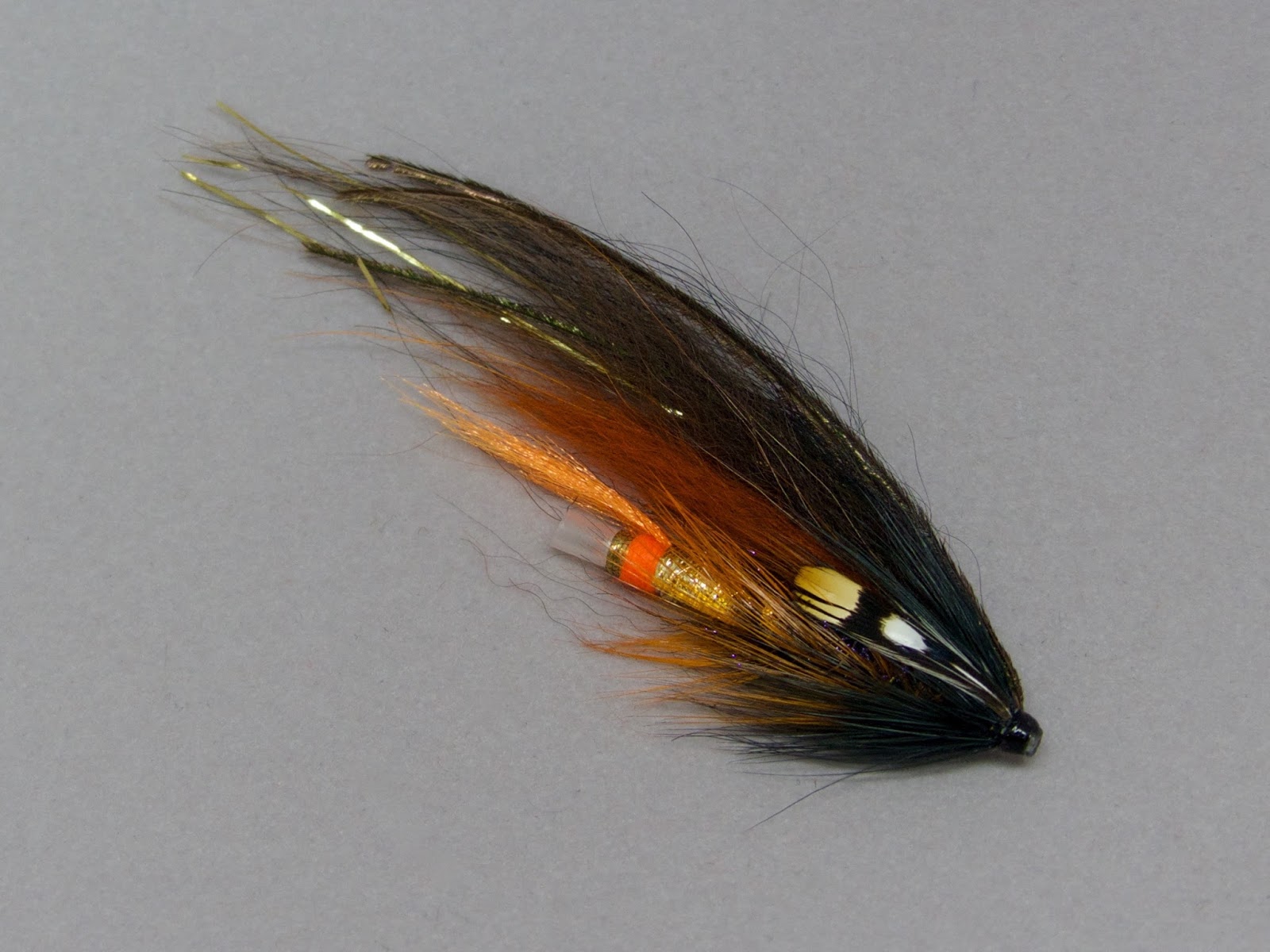
Fly wise, it was a day of stark contrast. My first fish was caught on a small #10 wet fly called the M1 Killer. I was fishing a very shallow riffle, so I decided to go small and subtle. The next three fish came from a deeper run with a much heavier current. The two middle fish (including the big guy) were taken on a Gold Bodied Willy Gunn tied on a brass tube. The total length of the fly was about 3.5"-4". The fourth fish took the orange HM Sunray Variant, a tube pattern which has been one of my top two salmon flies this fall (as well as being one of my top trout flies this past spring).

The other fly which has produced quite well for me is the venerable Ally's Shrimp. Still nothing on the Sugerman Shrimp since Russia, but I haven't been fishing it much this season for some reason. When I've needed a dark fly, I've been fishing the Same Thing Murray. Flies with orange in them have been producing so well, it's hard for me to fish with anything else.

Between playing gigs, teaching and fishing, I've been burning the candle at both ends lately. In between the insanity, I've been busy at the vise, tying flies for custom orders. As it gets colder, the less I fish with conventional flies and the more I fish with various tube flies. As far as single hooks go, I've been really happy with the Owner SSW straight eye hooks and I have been including them on all my tube fly orders lately.

Get out there and make sure you try some orange flies/tubes!

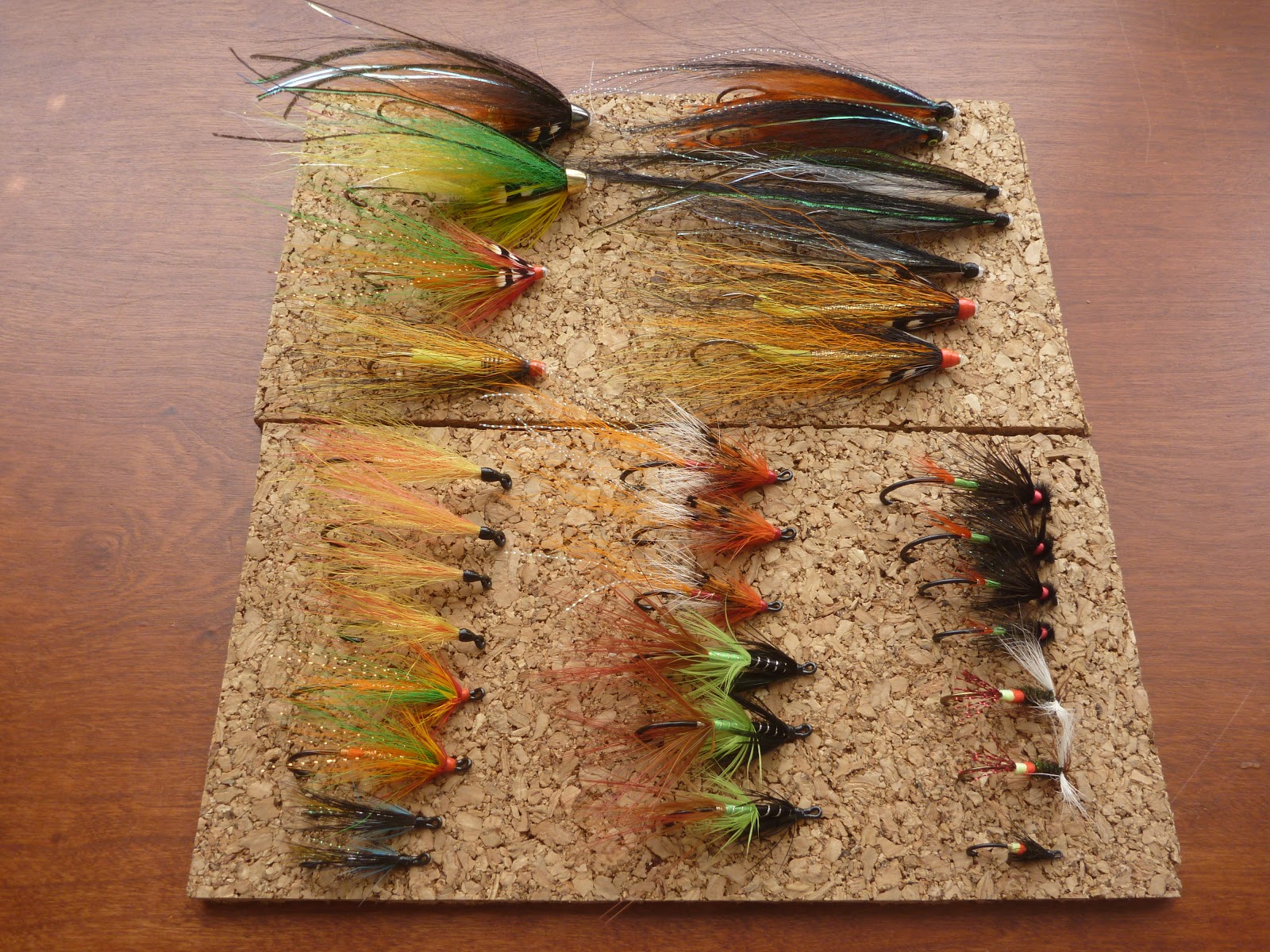
Expanded Naugatuck River Fly Assortment