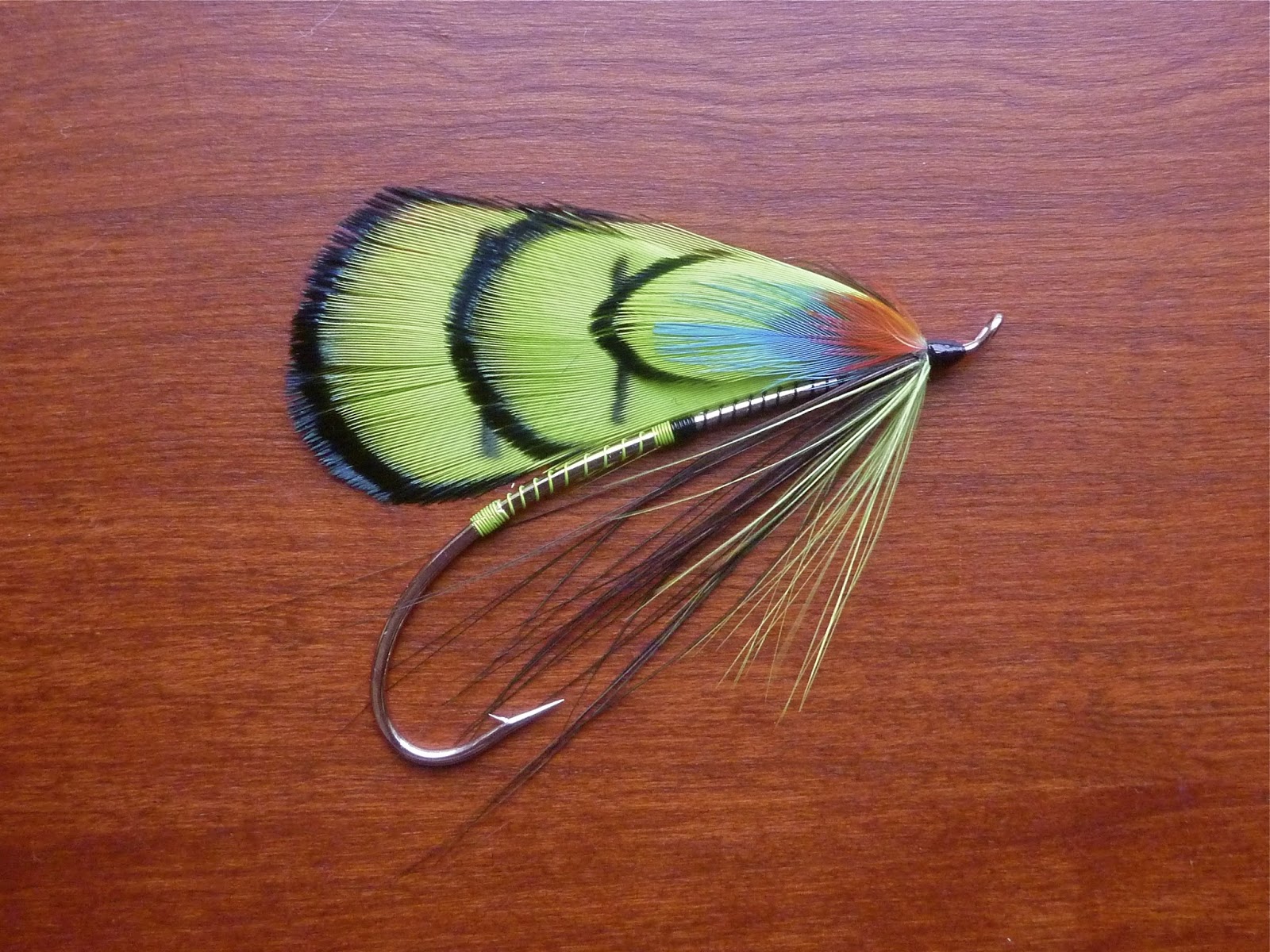
Monday, January 23, 2012

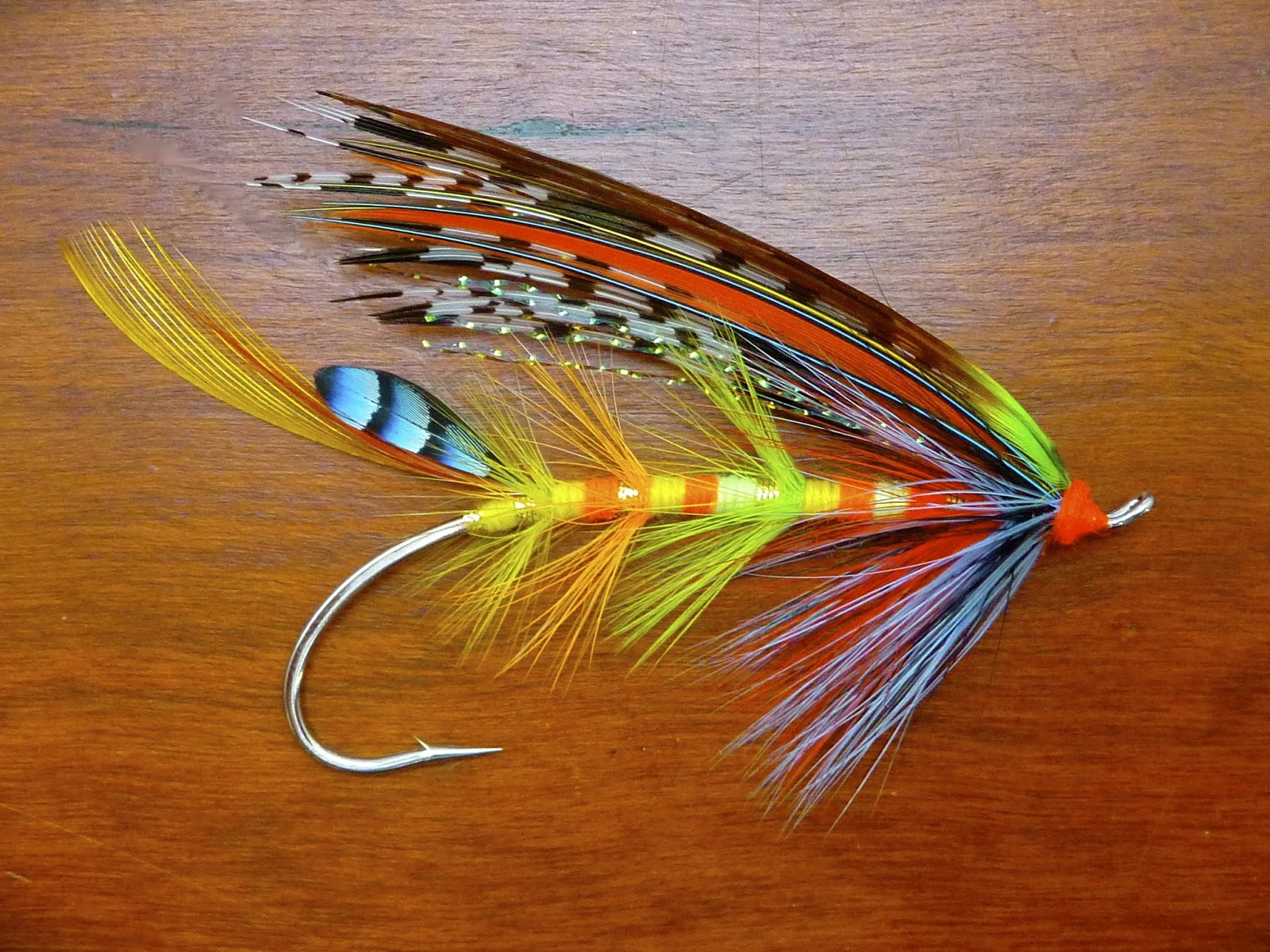
The Champion 5/0

The Champion-a formidable opponent

To the fly tyer not yet initiated and/or experienced in tying classic Atlantic salmon flies, Kelson's Champion probably doesn't look all that much different from the myriad of similar classic patterns. In fact, flashier flies like the Popham or the Jock Scott probably look more difficult to dress than the Champion. Don't let its relatively simple body construction fool you, however. The Champion has one of the toughest winging arrangements in all of classic salmon fly tying. In fact, I consider this one of the most difficult flies to dress of any, regardless of style or intended species (of known/established patterns). 

The difficulties really begin with the wood duck underwing. Because of its stem structure, wood duck is extremely difficult to set directly atop and parallel to the hook shank (when tied in by the stems, not by compressing the barbs of the feather). To practice the technique, the day before, I tied the Tomah-Jo, a Mary Orvis Marbury lake/bass fly. 
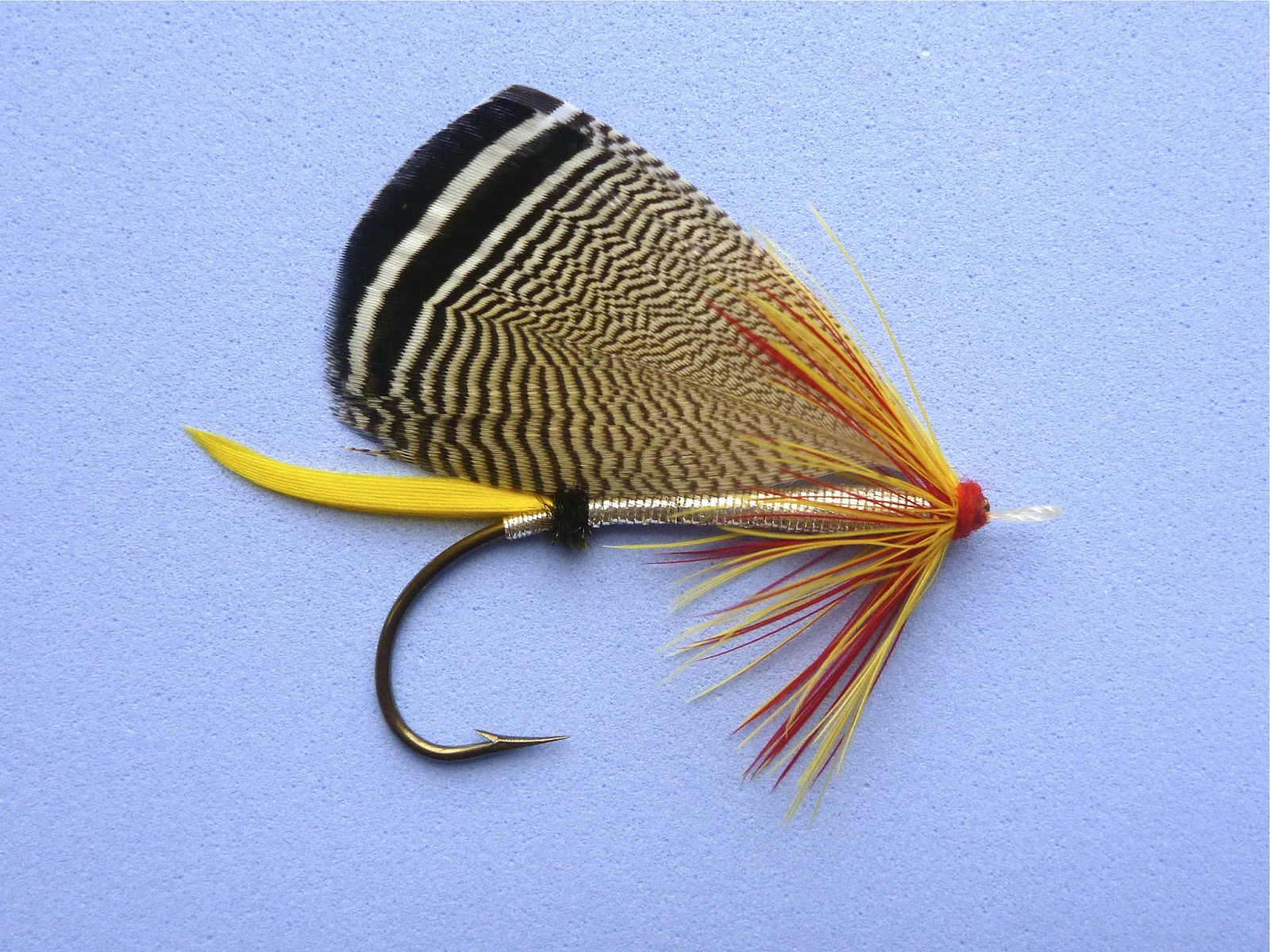
Tomah-Jo 3/0, as interpreted by Rossman/Boyer

The Tomah-Jo was my first attempt at tying full wood duck wings. I had no guide to go by, which was probably turned out to be a good thing in this case. As such, I kind of stumbled on a method of mounting the wood duck feathers which, as far as I know, is at least partially unique. I might document the method in a later blog post if I can get a good photo set up at my tying desk. Anyhow, successfully tying Tomah-Jo gave me the confidence to move on to the Champion.

Adding to the Champion's ornery nature is the individual application of later wing components. The married strips are added in small sets instead of all at once. One regret I have is that I did not marry the teal into the wing. My teal was too short for a fly this size. 

This was my first stab at the Champion. I tied it mostly from memory of Kelson's plate in "Land and Water". I do not own the book, so some things wound up being a little different than the original. If there is a next time around, I am going to tie this fly smaller and follow the "Land and Water" instructions as closely as possible. 

In all, I am very happy with the results, especially considering how large it is. I am no longer intimidated by stem-mounted wood duck wings. In fact, I'm looking forward to the next one. It was a pretty good way to spend a snowy weekend. 

Saturday, January 21, 2012

Ghost Stone Fly #2 Double

The Ghost Stone Fly...what a weird pattern!


In the world full of oddball patterns that is Atlantic salmon fly tying, this one is in the running for the strangest of all time. It is a variation of Lee Wulff's "Surface Stonefly," which is quite possibly an even stranger pattern. The history of these flies can be found on this great blog post from the FlySpoke Blog (which is one of my favorite blogs). 


This pattern first came to my attention a few years back during a phone call with Bryant Freeman of Eskape Anglers. I was up fishing the Miramichi and he was headed off to fish the Kedgewick. He mentioned that he and his friend had just caught some very large salmon on a variation of the Surface Stonefly and they were headed back for more. Last summer, I noticed my good friend Marc had some Wulff Stonefly variations in his fly box. He let me take one home to copy. Here is the Ghost Stone variation I tied:


Thread: Chartreuse 6/0
Hook: Sprite Double Salmon #2
Parachute Post: Straight pin with a clear glass bead
Tip: Oval silver tinsel
Body: Chartreuse Gordon Griffiths floss (coated with super glue for durability)
Wing: Black squirrel tail, under a few strands of holographic Flashabou, under white marabou
Hackle: Grizzly, wound parachute style on the straight pin (under the glass bead)


Top view

The business end


Tuesday, January 17, 2012

The Popham 3/0

The Popham - An oldie, but a goodie

This Popham is another fly from George M. Kelson's classic "The Salmon Fly". Being a professional jazz musician on a fixed budget, I opted not to use actual Indian Crow. Instead, I used a sub made by master tyer, material dyer and salmon fisherman, Bryant Freeman, proprietor of Eskape Anglers in Riverview, New Brunswick. If you're ever in the area, stop by Bryant's shop. Aside from having a plethora of tackle and tying materials, he tells a good story! 

Apparently, it's a very useful old Standard pattern

UPDATE: A very useful old standard pattern indeed...I raised a salmon on the Popham below (sz. 2), but I couldn't get him to fully commit to it. Fortunately, he had a taste for the Mickey Finn...

Tied to throw!


Wednesday, December 28, 2011

Sadidaym


Black and white, white with black stripes...

Further experiments with no body/wire ribbing and butts...the wire can be unforgiving at times.

This one has relatively few components; Alec Jackson 3/0 silver hook, black wire, silver wire, black floss, silver badger hackle and feathers from the silver pheasant, argus pheasant and jungle cock.

Saturday, December 24, 2011

Kropiwnicki's No. E for the River Branford (aka An Infamous Filthy Water Fly)

"Filthy is the way I likes it"
     
     This is an infamous flithy water fly for all salmon (and striper) rivers, particularly near Paul and Co. Hair Color and Design, and is not unlike the once celebrated "Hurricane Irene Fly". The favourite killer in all rivers of the Reverend St. Raphael's; there is no salmon (or striper) can resist its attractions in rapid pools in rivers near the sea. The preceding fly, No. D, will be found to kill better a few miles higher up from the sea (near Dynamic Racing Transmissions), as all plain flies do. If the No. D is winged with decomposing blue jay or seagull tail feather, it will be found just the thing.

     The wings are made of neck feathers from the krystal pigeon, in black and smolt blue, with broad strips of amherst pheasant on each side, and a strip each of scarlet and blue/yellow macaw tail feather, the former to be a little fuller than the latter, a Chinese red Uni-Yarn head (procured from Gourmet Wok) with a bunch of randomly coloured hackles round the shoulder, topped with two amherst pheasant crests dyed chartreuse.

     The body is made thus: - a tip of gold twist, a yellow Uni-Yarn tag, a topping of both golden and amherst pheasant with two small jay tips, the body is of sequentially alternating bands of the most offensive hues of Uni-Yarn, augmented with bands of gold twist and equally offensive hackle butts. No. 3/0 Alec Jackson hook in a most sterling silver, procured from the shop of the village metallurgist.

Wednesday, December 21, 2011

No Body 3/0...a test fly

A little experiment

I was just testing out a couple of design things with this one, so it's not as polished as what I'd usually tie/post. Maybe I'll fish this one...

Tuesday, December 13, 2011

The Hammer

The Hammer - sz. 5/0

As of a couple of weeks ago, the 2011 fishing season ended for me. It was a good season, but I'm ready to switch gears and move back to the tying bench for the winter. A lot of people enjoy fishing throughout the year, but I need time to cleanse the palette. I enjoy tying relatively involved flies and learning new techniques, most of which I'd never take the time to do while the fishing is hot. After a month or so, I'll have cabin fever, but I have a lot of good memories to reflect on this season past, as well as some adventures to look forward to (and tie for) in 2012.

Also, I absolutely detest the cold and snow. I wasn't made for this climate. If not for a career in music, I'd be living in Hawaii now! I guess that's why I'm not a steelheader.

Anyhow, aside from some classics for fishing, the "The Hammer" is kicking off the "fancy fly" tying season for me. Stay tuned for more to come...

The Hammer
-original design-

Hook: Mustad 3899 5/0
Tip: oval silver tinsel
Tag: red floss followed by green embossed tinsel
Tail: topping
Butts: light blue hackle, followed by red hackle, followed by ostrich herl
Body (1): red floss, ribbed with green embossed tinsel
Body (2): jungle cock nails, tied chatterer-style 
Body (3): "red feathers", tied chatterer-style, with one small jungle cock nail on each side
Bottom Wing/Throat: pair of jungle cock nails; kingfisher cheeks; two toppings below all
Wing: jungle cock nails with pair of dark green hackles slightly shorter than the j.c.; broad strips of amherst pheasant above; four toppings above all
Head: ostrich herl